











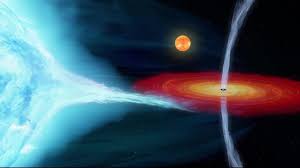
How Stellar Winds Revealed the Speed of Black Hole Jets
The “Dancing Jets” of Cygnus X-1: Measuring Instantaneous Power
In a groundbreaking study published in Nature Astronomy on April 16, 2026, an international team of astronomers led by Curtin University and the University of Oxford achieved a historic first. By observing the famous Cygnus X-1 system, they directly measured the instantaneous power and speed of jets erupting from a black hole.
The Discovery: 10,000 Suns in a Single Beam
Previously, scientists could only estimate the power of black hole jets by averaging data over thousands or millions of years. This new research provides a “real-time” snapshot of their energy:
-
The Power Output: The jets produce an energy output equivalent to 10,000 Suns.
-
The Speed: The material in these jets is moving at approximately 150,000 kilometers per second—exactly half the speed of light.
-
The Energy Budget: The study confirmed a long-standing theory that about 10% of the energy released as matter falls into a black hole is redirected and carried away by these powerful jets.
The Method: Watching the “Dance”
To make this measurement, researchers used a technique similar to how you might judge the strength of a water fountain by seeing how much a gust of wind bends the stream.
-
The System: Cygnus X-1 consists of a black hole (21 times the mass of the Sun) and a blue supergiant companion star (40 times the mass of the Sun).
-
The Stellar Wind: The supergiant star loses mass at an incredible rate, creating a fierce “stellar wind.”
-
The Deflection: Using a global network of radio telescopes (including the VLBA and EVN), the team tracked how this wind physically pushed and “bent” the black hole’s jets as they orbited each other. By calculating the force of the wind and the angle of the bend, they could solve for the jet’s true power.
Why This Matters for Galaxy Evolution
At zyproo.online, we analyze the “systems architecture” of the universe. This discovery is a critical piece of the puzzle:
-
Galactic Feedback: These jets act as a massive “feedback loop,” injecting energy into the surrounding space. This heat can prevent new stars from forming, effectively regulating the growth and size of entire galaxies.
-
An Anchoring Point: Because the physics of black holes is scale-invariant, this measurement in Cygnus X-1 (a small black hole) can be used to “anchor” our understanding of supermassive black holes at the centers of distant galaxies.