











The 3-Million-Light-Year Discovery That Surprised Astronomers
The Mystery of RXCJ0232–4420: A Giant Halo in a Quiet Cluster
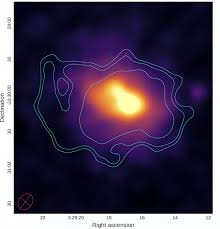
In a study reported on May 11, 2026, astronomers using two of the world’s most powerful radio arrays—the upgraded Giant Metrewave Radio Telescope (uGMRT) in India and the MeerKAT array in South Africa—confirmed a massive discovery. They found a giant radio halo stretching over 3.3 million light-years across a galaxy cluster known as RXCJ0232–4420.
Why This Discovery Is Unusual
In the world of astrophysics, radio halos are like “scars” from massive galactic collisions.
-
The Standard Rule: Giant radio halos are typically found in clusters that are undergoing violent mergers (massive “cosmic train wrecks”).
-
The Exception: RXCJ0232–4420 was long considered a “dynamically relaxed” or quiet cluster. Finding a halo this large in such a calm environment is extremely rare and challenges current models of how these structures grow.
The Technical Breakdown
At zyproo.online, we look at the data behind the discovery:
-
Scale: At 3.3 million light-years, this halo is more than 30 times the diameter of the Milky Way’s stellar disk.
-
Frequency Consistency: The halo was detected across every frequency examined by the team, proving it is a coherent, unified structure rather than a trick of light or chance alignment.
-
The Eastern Relic: Alongside the central halo, researchers identified a “radio relic” about 980,000 light-years long. Relics are usually tied to shock fronts, suggesting that while the cluster looks quiet now, it may have a more violent past than we realized.
The Global Collaboration
This discovery highlights the power of combining data from different parts of the world:
-
uGMRT (India): Provided the low-frequency sensitivity needed to detect the faint, diffuse emission of the halo.
-
MeerKAT (South Africa): Offered the high-resolution imaging required to map the exact boundaries of the structure.
-
The Team: Led by Pralay Biswas and a team of international collaborators, this research is now serving as a “natural laboratory” for studying particle acceleration in the intergalactic medium.