











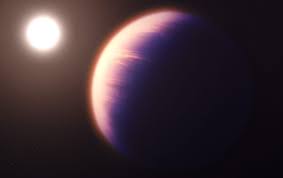
The Secret Life of a Lone Gas Giant
TOI-2031Ab: A Windows into the History of Gas Giants
In a study reported on May 9, 2026, astrophysicists led by Paul Smith from the University of Cincinnati shared groundbreaking findings on a “lonely” exoplanet named TOI-2031Ab. Using the James Webb Space Telescope (JWST), the team successfully analyzed the atmosphere of this distant world, providing new clues about how gas giants form and move through space.
The Planet: A “Puffy” Jupiter
Located 901 light-years from Earth, TOI-2031Ab is a study in extremes.
-
Size vs. Mass: The planet is roughly 25% larger in circumference than Jupiter, yet it has 20% less mass. This makes it a “puffy” gas giant, likely due to the intense heat from its nearby star expanding its atmosphere.
-
Extreme Orbit: It orbits its host star four times faster than Mercury orbits our Sun. A full “year” on this planet passes in just six Earth days.
-
Atmospheric Composition: JWST’s near-infrared sensors detected a cocktail of hydrogen, helium, water, and carbon dioxide, strikingly similar to our own Jupiter but under much more volatile conditions.
The “Time Machine” Effect
Because the planet is 901 light-years away, the data analyzed by the team in 2026 represents light that left the system in the year 1125.
“Its starlight captured in the space telescope was generated in the Middle Ages,” the researchers noted, highlighting the vast scales of time and space involved in exoplanet research.
Why This Discovery Matters
At zyproo.online, we analyze the “migration pathways” of cosmic architecture. This mission helps answer a fundamental question: How do big planets get so close to their stars?
-
Migration Theories: Most gas giants are thought to form far away from their stars (where it is cold enough for ices to gather) and then migrate inward. TOI-2031Ab’s isolation—it’s the only known planet in its system—provides a “clean” case study for migration without interference from other planets.
-
Habitability Context: By understanding how gas giants move, astronomers can better predict which solar systems might have stable “Goldilocks zones” where Earth-like planets could survive.