











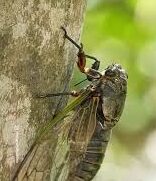
The “Dark Side” of Survival: How Cicadas Use Shadows to Find Trees
A study published in April 2026 in The American Naturalist has finally solved a decades-old mystery: How do blind-looking cicada nymphs, freshly emerged from the soil after 17 years, know exactly where the nearest tree is?
According to researchers from Georgetown University, the answer isn’t “mysterious waves” or scent—it’s a simple, light-based survival instinct called skototaxis.
1. Skototaxis: The Pull of the Dark
Skototaxis is the fancy scientific term for “movement toward darkness.” While many insects are attracted to light (phototaxis), cicada nymphs are programmed to do the exact opposite.
-
The Silhouette Strategy: In the dim light of dusk—when cicadas usually emerge to avoid birds—a tree trunk looks like a dark vertical patch against the slightly lighter sky.
-
Precision Marching: Researchers tracking Brood XIII nymphs found they “zoomed in” on trees with remarkable accuracy. On average, the insects traveled only 15% further than a perfectly straight line to reach their target.
-
The “Blind” Test: To prove it was visual, scientists temporarily obscured the eyes of some nymphs with white ink. These “blindfolded” cicadas wandered aimlessly in circles and rarely found a tree, while their “sighted” peers marched straight to the trunk.
2. A Universal Survival Logic
This “shadow-seeking” isn’t just for cicadas. It’s a fundamental code for survival across the insect world:
-
Ancient Instinct: Similar behavior is seen in beetles, crickets, and even honeybees. If a honeybee lands on water, it will swim toward the darkest part of the horizon, assuming it’s land.
-
The “Vine” Connection: The study notes that cicada nymphs use the same logic as tropical vine seedlings, which grow toward the darkest sector of their environment to find a host tree to climb.
3. Why It Matters for 2026
While 2026 isn’t a year for a “Mega Brood,” scientists are using this research to track “Shadow Broods” (stragglers that emerge 4 years early).
-
Brood XV Formation: In places like New Jersey and Virginia, researchers are monitoring stragglers from Brood II. These early risers are currently forming new “off-beat” populations.
-
Climate Nudge: Soil temperatures hitting the magic 64°F (18°C) are triggering these early emergencies. Knowing that these nymphs rely on shadows helps researchers predict where they will cluster in urban areas with scattered trees.
Cicada “Tree-Finder” Profile
| Feature | Description |
| Navigational Tool | Skototaxis (Darkness detection) |
| Visual Cue | Vertical dark shapes against a lighter background. |
| Efficiency | High (85% direct path accuracy). |
| Ideal Conditions | Dusk/Dim light (enhances silhouette contrast). |
| IT Analogy | Like a “pathfinding algorithm” that prioritizes the lowest pixel brightness. |