










Africa is Splitting: The 2026 “Critical Threshold” Update
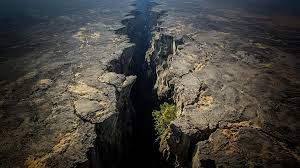
A major geological study published in May 2026 has confirmed that the African continent is splitting apart much faster than previously modeled. Geologists from Columbia University and the Lamont-Doherty Earth Observatory have found that a specific section of the East African Rift has officially reached a “critical threshold” of continental breakup.
While we typically think of tectonic shifts taking eons, this new data suggests that the Turkana Rift (spanning Kenya and Ethiopia) has entered an advanced, irreversible phase of separation.
1. The “Necking” Phase
The most significant finding in the May 2026 report is that the Earth’s crust in the Turkana region has entered a phase called “necking.”
-
Taffy Analogy: Imagine pulling a piece of saltwater taffy. Before it snaps, it stretches and becomes very thin in the middle. This narrowed part is the “neck.”
-
The 13km Mark: The researchers found that the crust in the center of the Turkana Rift is now only 13 kilometers (8 miles) thick. For comparison, the surrounding crust is over 35 kilometers thick.
-
The Inevitability: Once the crust thins below 15 kilometers, it becomes too weak to sustain itself. At this stage, the transition from a single continent to a new ocean floor is effectively guaranteed.
2. The Birth of the 6th Ocean
This isn’t just a crack in the ground; it’s the beginning of a new ocean basin.
-
The Plates: The Nubian Plate (most of Africa) is moving west, while the Somali Plate (the Horn of Africa) is moving east.
-
The Inundation: As the rift continues to widen and sink, water from the Red Sea and the Gulf of Aden will eventually flood the low-lying Afar Depression and the East African Rift Valley.
-
The Timeline: While “faster than thought” is true, we are still talking about 5 to 10 million years before a full ocean separates the two new landmasses. However, in geological terms, the “snap” has already begun.
3. A New Perspective on Human Evolution
The 2026 study also offers a surprising theory about our own history. The Turkana Rift is famous for being a “cradle of humanity” with thousands of early hominin fossils.
-
The Preservation Trap: Scientists now believe that the region wasn’t necessarily “more important” to our ancestors than the rest of Africa.
-
Rapid Burial: Instead, the necking process caused the ground to sink rapidly 4 million years ago. This created deep basins that filled with sediment very quickly, “locking in” and preserving fossils that would have eroded away anywhere else.
Continental Breakup Fact Sheet (2026 Data)
| Feature | Current Status (May 2026) |
| Active Zone | Turkana Rift (Kenya/Ethiopia) |
| Crust Thickness | 13 km (Critical Threshold reached) |
| Separation Rate | ~0.2 to 1.0 inches per year |
| Key Tectonic Players | Nubian, Somali, and Arabian Plates |
| Next Major Phase | Oceanization (Magma creates new seafloor) |