











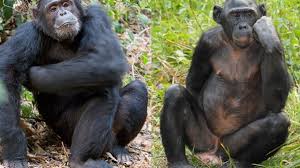
Beyond the Divide: New Study Reveals the Shared Evolutionary Roots of Apes and Humans
For decades, scientists have looked to our closest living relatives—chimpanzees and bonobos—to understand what makes us human. However, a landmark study published on April 23, 2026, and featured in The Guardian, suggests that the behavioral gap between us is far narrower than previously thought. The research provides a “unified theory” of ape behavior, proving that complex social traits once thought to be uniquely human are deeply embedded in our shared evolutionary lineage.
1. The Bonobo-Chimpanzee Paradox
The study tackles the long-standing “Dr. Jekyll and Mr. Hyde” comparison between our two closest relatives.
-
The Chimp Model: Traditionally viewed as violent and patriarchal, chimpanzees were seen as the mirror for human aggression and warfare.
-
The Bonobo Model: Viewed as peaceful, matriarchal, and sexually fluid, bonobos were the mirror for human cooperation and conflict resolution.
-
The New Discovery: Researchers found that both species exhibit high levels of “calculated altruism.” Bonobos are more aggressive than previously recorded, and chimpanzees engage in sophisticated “peace-brokering” that rivals human diplomacy.
2. Social Learning and “Culture”
One of the most striking findings in the 2026 report is the evidence of regional “dialects” and tool-use traditions.
-
Tool Innovation: The study documented a group of chimpanzees in a specific region using “multi-step” tool kits to extract honey—a skill passed down through generations.
-
Social Norms: Bonobo groups were observed enforcing “social penalties” on individuals who disrupted group harmony, suggesting a primitive form of justice and community policing.
3. The “Human” Emotional Spectrum
The researchers utilized advanced non-invasive neuro-imaging to study emotional responses in the wild.
-
Empathy and Grief: The study captured profound evidence of mourning rituals, where group members would stay with a deceased companion for days, exhibiting physiological signs of stress identical to human grief.
-
Forward Planning: For the first time, bonobos were observed “caching” or hiding resources specifically for the following day’s use, proving a cognitive ability to visualize the future.
4. Conservation as Self-Preservation
The Guardian report ends with a stark warning: as we uncover the “humanity” in these great apes, they are slipping closer to extinction.
-
Genetic Goldmines: Every lost ape colony is a lost chapter of our own history. The study argues that protecting ape habitats is not just an environmental issue, but a scientific necessity for understanding the human mind.
-
The 2026 Census: New data suggests that habitat fragmentation has reached a critical point, with only a few “genetically viable” corridors remaining for bonobos in the Congo Basin.