











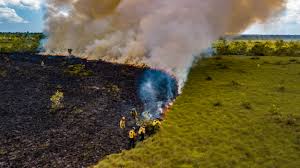
The Fire Age: Navigating the New Reality of Global Wildfires
Wildfires are a natural part of many ecosystems, but their behavior is changing at a rate that is challenging our ability to adapt. As explored by National Geographic on May 8, 2026, we have entered a “New Era of Fire.” While fire has historically cleared underbrush and stimulated new growth, the modern combination of climate shifts and human encroachment has transformed these seasonal events into year-round “mega-fires” that redefine landscapes.
1. The Anatomy of a Modern Wildfire
A wildfire requires three ingredients, known as the “Fire Triangle”: Fuel, Oxygen, and Heat.
-
The “Tinderbox” Effect: Rising global temperatures are sucking moisture out of vegetation, turning forests into standing fuel. National Geographic highlights that even traditionally damp environments, like the rainforests of the Amazon and the boreal forests of the North, are now seeing unprecedented burn rates.
-
The Fire Weather Loop: Large wildfires are now creating their own weather systems. Massive “pyrocumulonimbus” clouds can generate lightning and “fire tornadoes,” which in turn start new fires miles away from the original blaze.
2. The Human Footprint: The “WUI” Problem
One of the most significant lessons of 2026 is the danger of the Wildland-Urban Interface (WUI)—the zone where human developments meet undeveloped wildland.
-
Ignition Sources: Nearly 85% of wildfires in the U.S. are started by humans, whether through downed power lines, unattended campfires, or discarded cigarettes.
-
Encroachment Risks: As housing expands into fire-prone areas, the “natural” cycle of fire becomes a humanitarian disaster. Firefighters are increasingly forced to prioritize protecting property over containing the fire’s perimeter, often allowing the blaze to grow larger in the wilderness.
3. Ecological Paradox: Good Fire vs. Bad Fire
Not all fire is destructive. Scientists are emphasizing the “Wonder Lesson” of fire’s role in biodiversity.
-
Serotiny: Many tree species, like the Giant Sequoia and certain pines, have cones that require the intense heat of a fire to open and release their seeds.
-
Prescribed Burns: To prevent mega-fires, indigenous communities and park rangers are returning to the practice of “cultural burning”—low-intensity fires set intentionally to clear out “ladder fuels” that would otherwise lead to catastrophic canopy fires.
4. Tech and the Future of Containment
The way we fight fire is being revolutionized by the same technology used in space and AI:
-
Satellite Detection: New infrared satellite constellations can now detect a “heat signature” the size of a campfire from orbit, allowing crews to respond before a fire becomes uncontrollable.
-
AI Modeling: Fire behavior is now predicted using AI that accounts for real-time wind gusts, humidity levels, and topography, giving evacuation notices much-needed precision.
-
The Smoke Impact: Beyond the flames, the smoke from these fires is becoming a global health crisis, carrying fine particulate matter (PM2.5) thousands of miles and affecting air quality in distant cities.