










Deep Space Power: NASA’s Record-Breaking Ion Engine Passes First Test for Mars Missions
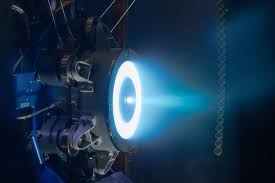
In a massive leap toward human exploration of the Red Planet, NASA has successfully completed the first test firings of a powerful new electric propulsion system. As reported by Space.com on May 5, 2026, this prototype—a lithium-fed magnetoplasmadynamic (MPD) thruster—shattered existing records, reaching power levels essential for carrying massive crewed vessels across the solar system.
The test represents a 25-fold increase in power over current state-of-the-art ion engines, proving that the technology required for a six-month journey to Mars is no longer just theoretical.
The Breakthrough: Lithium Metal Vapor
While traditional ion engines (like those on the Psyche mission) typically use xenon gas, this new engine utilizes lithium metal vapor.
-
The Lorentz Force: The engine generates powerful electrical currents that interact with a magnetic field to accelerate lithium ions.
-
Mass Efficiency: Lithium is the lightest metal on the periodic table. Its low atomic mass allows the engine to achieve much higher ejection velocities than heavier xenon, meaning it can provide more thrust using significantly less fuel.
-
Fuel Savings: NASA estimates that using this electric propulsion can reduce a spacecraft’s propellant mass by up to 90% compared to traditional chemical rockets.

Test Results: 120 Kilowatts and Beyond
The prototype was put through its paces at the Condensable Metal Propellant (CoMeT) vacuum facility at NASA’s Jet Propulsion Laboratory (JPL).
-
Record Performance: The thruster reached 120 kilowatts (kW) of power during five separate test firings on February 24, 2026.
-
Comparison: For context, the ion engines currently powering the Psyche probe operate at roughly 4.5 kW.
-
Extreme Endurance: During the tests, the thruster withstood temperatures exceeding 2,800°C (5,000°F), a necessary hurdle since the engine must run continuously for years during a round-trip mission.
The Road to the Red Planet
Despite the successful 120 kW test, NASA officials—including current Administrator Jared Isaacman—emphasize that this is only the first step.
-
Megawatt Targets: A crewed mission to Mars is estimated to require between 2 and 4 megawatts (MW) of power. Engineers plan to achieve this by scaling up individual thrusters to the 500 kW–1 MW range and then “strapping” multiple units together.
-
The Nuclear Connection: To generate the massive amount of electricity needed to run these thrusters in deep space, NASA is simultaneously developing space-ready nuclear reactors, such as the SR-1 Freedom.
-
Operational Lifespan: Future versions of the engine must be able to operate for more than 23,000 hours (roughly 2.6 years) to cover the entire duration of a human mission to Mars and back.