










The Act of Dying: Juan de Fuca Plate Caught “Tearing Apart” Beneath the Pacific Northwest
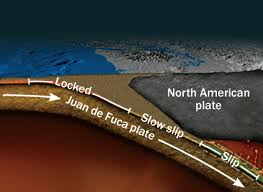
In a major geological discovery reported on May 1, 2026, scientists have captured the first clear images of a subduction zone in the process of a structural breakdown. Using advanced seismic imaging—essentially an “ultrasound” of the Earth—researchers have found that the Juan de Fuca Plate is not descending into the mantle as a solid slab, but is instead fragmenting and tearing apart beneath the Cascadia Subduction Zone.
This phenomenon, described by lead researcher Brandon Shuck as a “slow-motion train derailment,” offers a rare look at how these massive tectonic systems eventually shut down and “die.”
The Anatomy of a Tectonic Tear
The study, published in Science Advances, reveals that the plate is undergoing a process known as piecewise termination. Rather than a clean slide, the oceanic crust is buckling and snapping under the immense pressure of the North American Plate.
-
A Massive Fault: Imaging revealed a 75-kilometer-long tear where a section of the plate has dropped by about five kilometers vertically.
-
The “Scissors” Effect: Scientists identified transform boundaries acting like natural scissors, cutting across the plate and allowing smaller “microplates” to detach and sink at different rates.
-
The Quiet Gaps: One of the most telling clues was a lack of earthquakes in certain areas. Scientists explain that once a piece of the plate has completely broken off, it no longer produces seismic activity because the rocks are no longer “stuck” together.
Why Is the Plate Breaking?
The Juan de Fuca is one of Earth’s smallest tectonic plates and is a remnant of the ancient Farallon Plate. Its current fragmentation is driven by two main factors:
-
Extreme Thinness: In many areas, the subducting plate is less than 6 kilometers thick, making it prone to buckling and tearing.
-
Buoyancy: Because the plate is relatively young and “warm,” it tends to float more easily. Forcing this buoyant material deep into the mantle creates internal stresses that eventually lead to a structural snap.
What This Means for the “Big One”
The discovery of these tears has sparked a debate about the future of seismic risk in the Pacific Northwest (stretching from Vancouver Island to Northern California).
-
Improved Modeling: Understanding these fractures will allow geologists to create more accurate models of how seismic energy travels. A tear might act as a barrier, preventing a rupture from traveling the entire 1,000 km length of the fault, or it could create new, unpredictable stress points.
-
No Immediate Change in Risk: Experts emphasize that this is a geological process taking place over millions of years. The Cascadia Subduction Zone remains a “megathrust” fault fully capable of producing a Magnitude 9.0 earthquake and a major tsunami.
-
Volcanic Implications: The tears in the plate create “slab windows” where hot mantle material can rise. This could potentially lead to shifts in volcanic activity along the Cascade Volcanic Arc over very long time scales………….
The “Death” of a Subduction Zone
This research settles a long-standing geological puzzle. If subduction zones never stopped, oceans would disappear and continents would pile up indefinitely. We now see that they “die” not by stopping all at once, but by shredding into pieces, losing the downward “pull” that keeps the conveyor belt moving.