











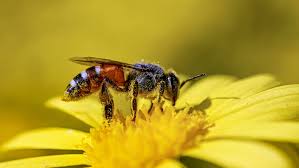
The Bee “Calculator”: Why Scientists Now Believe Bees Can Truly Count
A groundbreaking study published in late April 2026 in Proceedings of the Royal Society B has finally settled a long-standing scientific debate: Bees can actually count.
For years, critics argued that bees weren’t “counting” numbers like 1, 2, or 3, but were instead using “visual shortcuts”—simply picking the card that looked “busier” or had more edges. However, researchers from Monash University and the University of Trento used a new approach that accounts for the unique biology of bee vision to prove the “cheating” theory wrong.
1. Seeing Through a Bee’s Eyes
The 2026 breakthrough happened when scientists stopped looking at the experiment through human eyes and used bio-inspired mathematical modeling to simulate how a bee actually perceives shapes.
-
The “Visual Clutter” Myth: Humans see a card with 5 dots as more “complex” than a card with 2 dots.
-
The Bee Reality: Because bees have lower visual resolution, many of the fine details and “busy” patterns humans see actually disappear for them.
-
The Result: When scientists filtered the images to match bee vision, they found that the “visual shortcuts” (like edge density) were no longer reliable. The bees still chose the correct quantities, meaning they were responding to the actual number of objects, not just the “messiness” of the image.
2. Math Skills of a “Sesame Seed” Brain
Despite having fewer than one million neurons (compared to a human’s 86 billion), bees have mastered concepts that many “higher” animals struggle with:
-
Counting to Six: Bees can consistently distinguish quantities up to six.
-
The Concept of Zero: In 2026, researchers confirmed that bees understand zero as a numerical value—realizing that “nothing” is less than “something.”
-
Greater vs. Less: They can successfully apply “greater-than” and “less-than” rules to new sets of numbers they have never seen before.
-
Odd and Even: Some studies even suggest they can learn the difference between parity (odd and even numbers), a high-level abstract task.
3. Why It Matters for AI and Evolution
As an IT student, this research has direct applications for your field:
-
Minimalist Neural Networks: If a bee can do math with a tiny brain, it proves that we don’t need massive, energy-hungry supercomputers for basic logical processing. AI researchers are using “bee logic” to build more efficient, low-power neural networks.
-
Universal Math: It suggests that “number sense” isn’t a human cultural invention, but an ancient evolutionary tool shared by many different types of brains.
Bee vs. Human Numerical Logic
| Feature | Human Approach | Bee Approach |
| Brain Size | ~86 Billion Neurons | ~960,000 Neurons |
| Learning Speed | Slow (Zero takes years to learn) | Fast (Hours of training) |
| Max Count | Infinite (with language) | ~6 (Subitizing-like limit) |
| Odd/Even Bias | Faster at categorizing “Even” | Faster at categorizing “Odd” |