











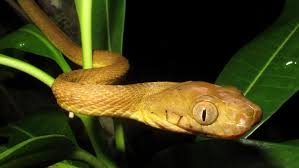
Snakes Defying Gravity: The Secret to “Standing Tall”
Research published in the Journal of the Royal Society Interface in February 2026 has finally explained how snakes—creatures with no limbs and a flexible, “floppy” body—can lift up to 70% of their length straight into the air without toppling over.
A team from Harvard University and the University of Cincinnati used high-speed video and mathematical modeling to reveal that snakes don’t use brute strength, but a very clever physics trick.
1. The “Boundary Layer” Strategy
Most people assume a snake must stiffen its entire body to stand up. However, the study found that snakes do the exact opposite.
-
Localized Control: Snakes concentrate almost all their muscular effort and bending into a tiny “boundary layer” near their base (where they are anchored to a branch or the ground).
-
The Vertical Advantage: By making the base rigid and the rest of the body almost perfectly vertical, the snake minimizes the effect of gravity. When a flexible object is perfectly vertical, gravity has zero “leverage” to bend it.
-
Energy Efficiency: This strategy allows them to stand tall while expending very little energy. It’s the biological equivalent of balancing a broomstick on your finger—the effort is all at the bottom.
2. The Real Challenge: The Inverted Pendulum
While lifting up is surprisingly easy for a snake, staying up is the hard part.
-
Proprioception: Snakes use their sense of “self-shape” (proprioception) to detect the slightest tilt.
-
The Swaying Act: If you’ve ever seen a snake “standing” and swaying gently, you’re watching real-time physics. They are constantly making tiny muscular adjustments to stabilize themselves, much like an inverted pendulum.
-
Dynamic Stability: The study revealed that snakes actually use more force to stay balanced than they do to initially lift themselves up.
3. Applications in Soft Robotics
As an IT and Tech student, this is where it gets interesting for you. Engineers are already using this “active elastic filament” model to design the next generation of robots.
-
Snake-Bots: Future robots used for space exploration or disaster relief (like searching through rubble) will likely use this “boundary layer” control to reach high ledges without needing heavy, energy-draining motors in every joint.
-
Minimalist Coding: Instead of a complex AI managing every “vertebra” of a robot, engineers can now use a simpler algorithm that focuses control at the base, just like the tree snake.
Standing Snake Comparison
| Species | “Standing” Height (% of body) | Primary Environment |
| Brown Tree Snake | ~50% – 60% | Tropical Canopy |
| Scrub Python | ~70%+ | Rainforests |
| Cobra (Strike Pose) | ~30% | Ground/Grassland |