











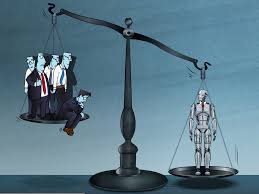
Landmark Ruling: China Blocks AI-Based Layoffs
In a decision published in late April 2026, the Hangzhou Intermediate People’s Court set a historic legal precedent by ruling that companies cannot fire employees simply because their roles can now be performed by Artificial Intelligence.
This ruling, released just before International Workers’ Day (May 1st), sends a powerful message that technological advancement does not override labor protections.
1. The Case of “Zhou”
The ruling stems from a dispute between a senior tech worker (identified as Zhou) and his employer, an AI hub in Hangzhou.
-
The Conflict: Zhou was a quality assurance supervisor earning 25,000 yuan ($3,450) per month. As the company’s Large Language Models (LLMs) became more advanced, they began performing Zhou’s tasks of filtering and matching user queries.
-
The Demotion Offer: The company attempted to reassign Zhou to a lower-level position with a 40% pay cut (down to 15,000 yuan).
-
The Termination: When Zhou refused the pay cut, the company fired him, citing “organizational restructuring” and “major changes in objective circumstances.”
2. Why the Court Ruled for the Human
The court’s decision rested on a specific interpretation of Article 40 of China’s Labor Contract Law, which allows for termination only if “objective circumstances” change so much that a contract becomes impossible to perform (like a natural disaster or a company merger).
-
Voluntary Choice vs. Objective Force: The court ruled that adopting AI is a voluntary business decision made to stay competitive, not an external, uncontrollable event. Therefore, it does not meet the legal threshold for breaking a contract.
-
Unfair Reassignment: Offering a 40% salary reduction was deemed “unreasonable.” The court established that any reassignment due to tech changes must maintain the worker’s dignity and economic standing.
-
Shifting the Risk: The judge noted that companies cannot “shift the risks of technological iteration onto their employees” while keeping 100% of the efficiency gains for themselves.
3. A Rising Trend in 2026
This isn’t an isolated event. China is currently balancing its race for AI dominance with a desperate need for social stability amid high youth unemployment.
-
Beijing Precedent: A similar ruling occurred in Beijing involving a map data collector who was replaced by AI. The court there also ruled the dismissal unlawful.
-
Global Contrast: These rulings create a sharp contrast with the US and EU. While US tech giants have laid off nearly 80,000 workers in early 2026 (attributing many to AI spending), China is using its legal framework to slow the human cost of automation.
Comparison of Global AI Layoff Protections (2026)
| Region | Legal Standing | Key Philosophy |
| China | Illegal (in recent rulings) | AI is a “voluntary choice,” not a “major objective change.” |
| USA | Legal | “At-will” employment generally allows for tech-based restructuring. |
| EU | Limited | Focused more on AI ethics/safety than job-preservation contracts. |