










The “Bay Death Trap”: Gray Whales and Vessel Strikes
A sobering study published in Frontiers in Marine Science (April 2026) and reported by Science News has highlighted a deadly new trend: San Francisco Bay has become a high-risk “ecological trap” for migrating gray whales.
As the Eastern North Pacific gray whale population struggles with a 50% decline since 2016, the Bay—once a rare sight for the species—is now a frequent and often fatal stopover.
1. The 18% Mortality Rate
Researchers from The Marine Mammal Center and Sonoma State University used photo-identification to track 114 individual whales that entered San Francisco Bay between 2018 and 2025. The results were startling:
-
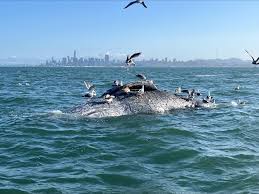
Fatal Detours: At least 18% of the whales identified in the Bay were later found dead in the local area.
-
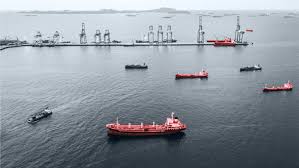
The Bottleneck Effect: The Golden Gate Strait acts as a geographic bottleneck. Both massive container ships and whales must pass through this narrow opening, making collisions almost inevitable in such a high-traffic urban waterway.
-
Low Resighting: Only 3.5% (four individuals) were ever seen in the Bay in a subsequent year. This suggests that the Bay is either a “one-way trip” for many or a place they actively learn to avoid if they survive.
2. The Deadly Combination: Starvation + Speed
The study suggests that whales aren’t just dying of one cause; they are being hit by a “double whammy” of environmental and human factors.
-
The Hunger Catalyst: Climate change is disrupting Arctic ice, killing the tiny crustaceans gray whales eat. Hungry whales are forced to enter San Francisco Bay to forage for alternative food like herring roe.
-
The “Slow” Response: Malnourished whales are often “running on empty.” These weakened animals likely have less energy to dive or maneuver away from fast-moving ferries and cargo ships.
-
Visibility Issues: Gray whales have a very low profile when surfacing. In the heavy fog common to San Francisco, they are nearly invisible to boat captains until it is too late.
3. Recent Crisis (Spring 2026)
The situation has reached a critical point this year. Between mid-March and April 2026, at least six gray whales were found dead in San Francisco Bay alone.
-
Widespread Impact: Similar deaths are being reported along the entire West Coast, with strandings in Oregon and Washington reaching record early-season highs in 2026.
-
Calf Shortage: Calf production has hit historic lows. Without new births to replace the adults dying in ship strikes, the population’s ability to rebound is in serious doubt.
Comparison of Whale Death Causes (SF Bay Area)
| Cause of Death | Percentage of Cases | Key Factor |
| Vessel Strike | ~40% – 43% | Blunt force trauma or propeller deep-tissue lacerations. |
| Malnutrition | ~30% | Lack of blubber/fat reserves; visible “peanut head” shape. |
| Unknown/Other | ~27% | Advanced decomposition or entanglement. |