











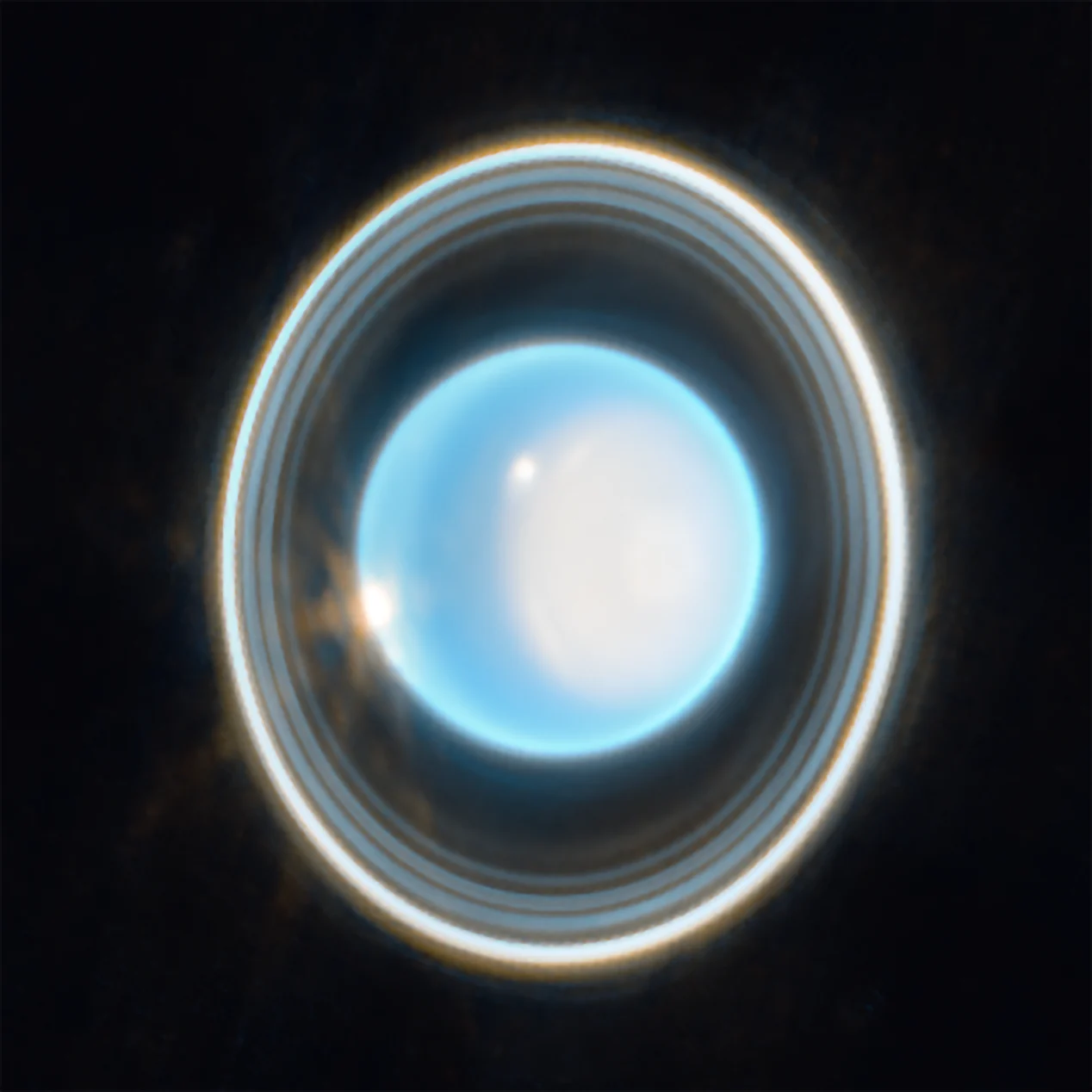
A Tale of Two Rings: Why Uranus’s Faintest Orbits Are Different Colors
The Colorful Secrets of the Uranian Rings While Saturn’s rings are the showstoppers of the solar system, Uranus holds a spindly set of narrow rings that are much harder to see. Recently, a team led by Professor Imke de Pater at UC Berkeley used high-resolution “reflectance spectra” to decode the light bouncing off these rings. What they found was a stark contrast: the μ (mu) and ν (nu) rings look nothing alike.
The Blue Ring: The Icy Mystery of μ (Mu) Located about 98,000 kilometers above the planet’s clouds, the μ ring glows with a distinct blue hue.
-
The Composition: It is made primarily of tiny, sub-micron-sized water ice particles.
-
The Source: Scientists have traced this material back to the small moon Mab. Just as Saturn’s moon Enceladus feeds its blue E-ring, tiny impacts on Mab’s icy surface knock off grains that form the μ ring.
-
The Rarity: Before this discovery, Saturn’s E-ring was the only blue ring known in our solar system.
The Red Ring: The Dusty Archive of ν (Nu) Closer to the planet (at 67,000 kilometers) lies the ν ring, which appears red in the spectra.
-
The Composition: Unlike its icy blue neighbor, the ν ring is dusty and rich in organic materials—specifically carbon-rich compounds.
-
The Source: This ring is likely created by micrometeorite impacts on hidden, rocky bodies that orbit between the known moons.
-
The Contrast: While the blue ring is dominated by ice, the ν ring is about 10–15% organic dust.
Why Are They So Different? The big question for planetary scientists is why two rings so close to each other have such vastly different “parent” materials. It suggests that the history of Uranus’s moons is more complex than we thought. While most inner moons are rocky, Mab’s icy nature remains a mystery.
What’s Next? These rings are relatively young—only about 500 to 600 million years old. They are constantly being “refreshed” by collisions and impacts. Scientists will continue to use the JWST to monitor these rings for shifts in brightness, which could signal new activity or collisions within the system.