











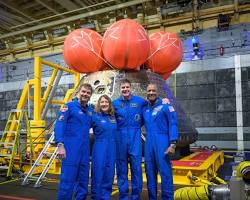
Artemis 2 Crew Returns: A Hero’s Welcome After Historic Moon Mission
The world has welcomed home the crew of Artemis 2, the first humans to venture to the lunar vicinity in over half a century. Following their successful journey around the Moon, the four astronauts are receiving “star treatment” as they transition from the deep cold of space to a whirlwind of global celebration and scientific debriefing.
1. The Historic Milestone
The Artemis 2 mission represents a monumental leap in NASA’s goal to establish a long-term human presence on the Moon.
-
The Mission: A 10-day flight that tested the Orion spacecraft’s life-support systems while carrying humans farther into space than any person since the Apollo era.
-
The Crew: Commander Reid Wiseman, Pilot Victor Glover, Mission Specialist Christina Koch, and Mission Specialist Jeremy Hansen (of the Canadian Space Agency).
-
Lunar Flyby: The crew completed a “free-return” trajectory around the Moon on April 6, 2026, capturing breathtaking high-resolution footage of the lunar far side before heading back to Earth.
-
A Solar Surprise: During the flyby, the crew witnessed a total solar eclipse from space—an event lasting nearly 54 minutes from their unique vantage point.
2. The “Star Treatment”
Since their splashdown on April 10, 2026, off the coast of San Diego, the crew has been at the center of a global media tour and scientific celebration:
-
Homecoming in Houston: The astronauts have since returned to the Johnson Space Center to reunite with their families and begin the “hero’s welcome” phase of the mission.
-
Scientific Debriefs: Between the celebrations, the astronauts are undergoing rigorous medical checks and mission debriefs to provide data that will be crucial for the upcoming Artemis 3 lunar mission.
-
Inspiring the Artemis Generation: A major focus of their post-flight tour has been engaging with students and young scientists, emphasizing that this is only the beginning of a new era of exploration.
3. Key Takeaways from the Flight
-
Record-Breaking Distance: The crew traveled farther from Earth than any humans in history.
-
System Validation: Despite minor “creature comfort” issues—like a brief glitch with the Orion’s space toilet—the spacecraft’s critical life-support and heat shield systems performed exceptionally.
-
Lunar Science: The crew provided detailed observations of the Orientale Basin, a massive lunar crater that had never been seen in sunlight by human eyes until this mission.
4. What This Means for Artemis 3
The success of this mission provides the “green light” for the next phase. While Artemis 2 was a flyby, Artemis 3 (currently targeted for late 2027) will aim to return humans to the lunar surface. The data gathered by Wiseman, Glover, Koch, and Hansen regarding radiation exposure and spacecraft performance is currently being integrated into the planning for that next giant leap.