











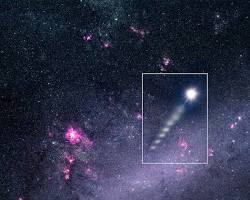
The Galactic Outcast: DESI-HVS1 and the Secret of the Milky Way’s Core
In a breakthrough for “chemical tagging” and galactic archeology, astronomers have identified DESI-HVS1, a rare hypervelocity star (HVS) that is currently fleeing the Milky Way. Reported in late April 2026, this discovery—made using the Dark Energy Spectroscopic Instrument (DESI) and the Gaia satellite—is rewriting what we know about the stars that live near our galaxy’s central supermassive black hole.
1. The Discovery: An Old Traveler in a Young Man’s Game
Most hypervelocity stars found to date have been young, massive, blue stars. DESI-HVS1 is different, and that’s why it’s a big deal.
-
The Profile: It is an old, low-mass, metal-poor F-type star. While most HVSs are “young celebrities,” this star is approximately 14 billion years old—nearly as old as the universe itself.
-
The Origin: By integrating its orbit backward, scientists have traced its path directly to the Galactic Center (GC), confirming it was ejected from the heart of the Milky Way.
-
The Location: It was found in the inner halo of our galaxy, roughly 12,000 light-years away from Earth.
2. The Ejection: The “Hills Mechanism” in Action
How does a star get thrown out of a galaxy? It usually takes a gravitational giant.
-
The Binary Tussle: Astronomers believe DESI-HVS1 was once part of a binary star system (two stars orbiting each other).
-
The Black Hole: About 13 million years ago, this pair strayed too close to Sagittarius A*, the supermassive black hole at the center of the Milky Way.
-
The Breakup: In a process called the Hills Mechanism, the black hole’s gravity captured one star and “slingshot” the other (DESI-HVS1) outward at a blistering speed of 682 km/s.
3. Why This Star is a “Time Capsule”
Because the center of our galaxy is clogged with thick dust and gas, it is incredibly hard for telescopes to see the stars that live there.
-
Chemical Messenger: DESI-HVS1 acts as a “sample” delivered to our doorstep. By studying its light, astronomers can learn about the chemical makeup of the stars that formed in the Galactic Center billions of years ago.
-
Low-Metallicity Mystery: Its low metal content ($[Fe/H] = -1.6$) suggests it comes from a very old population of stars that formed before the galaxy was enriched with heavier elements.
-
Debunking Selection Bias: Its discovery proves that the “young” bias of previous HVS finds was just because young stars are brighter and easier to see. The Galactic Center has been flinging out stars of all ages for billions of years.
4. The Fate of DESI-HVS1
Will it stay or will it go?
-
The Speed Limit: The star is moving at roughly 523 km/s relative to the galactic center.
-
Unbound Probability: Scientists estimate there is a 50% chance it is “unbound,” meaning it has enough energy to eventually leave the Milky Way entirely and drift into the void of intergalactic space forever.