











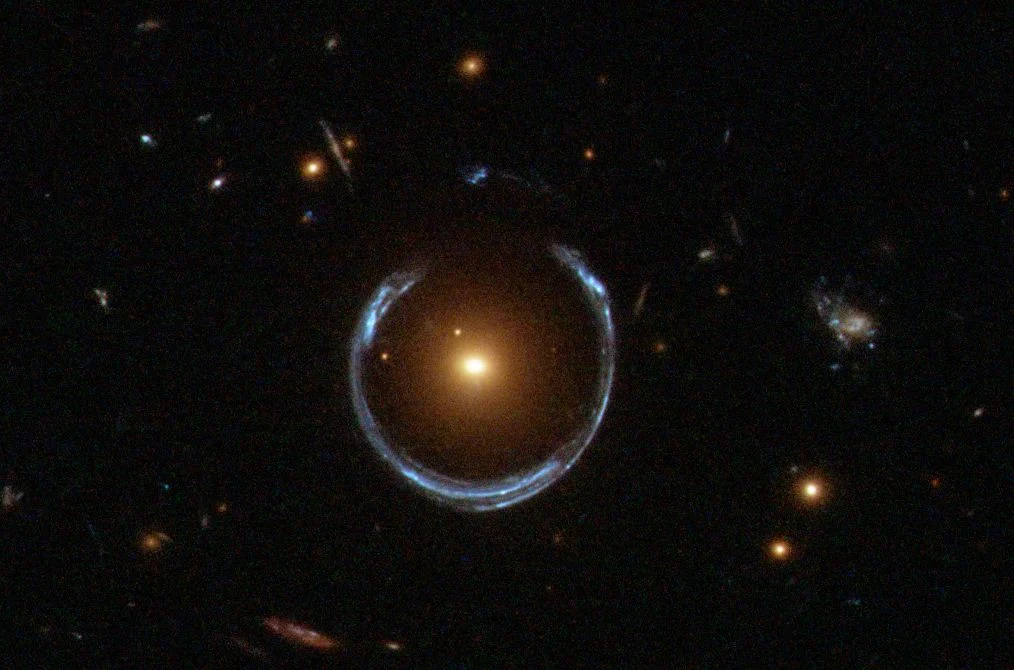
The Universe’s Magnifying Glass: Joining the Hunt for Gravitational Lenses
The Universe Bending Light Around Corners Imagine holding a wine glass up to a candle. The curved base of the glass distorts the flame, stretching the light into glowing arcs and circles. On a cosmic scale, a similar effect happens when a massive object, like a galaxy cluster, sits directly between Earth and a distant background galaxy. The gravity of the foreground object warps space, forcing the distant light to bend around it. This is a gravitational lens.
The Hunt for Einstein Rings When the alignment between the foreground “lens” and the background “source” is nearly perfect, the distant galaxy appears as a glowing, circular halo known as an Einstein Ring. These rings aren’t just beautiful; they are vital scientific tools. They act as natural weighing scales, allowing astronomers to calculate the total mass of a galaxy—including its invisible dark matter.
Euclid’s Massive Discovery The Euclid telescope has just released a dataset containing roughly 72 million galaxies. While AI has been used to narrow down the candidates, the human eye is still the champion at recognizing the subtle, irregular arcs that signal a true lens.
-
The Goal: Scientists hope to discover over 10,000 new lenses from this search alone.
-
The Record: This would be more than all the lenses discovered in the history of astronomy combined.
-
The Progress: In a preliminary scan of just 0.04% of the data, researchers found 500 previously unknown lenses.
How You Can Help: Space Warps You don’t need a PhD or a telescope in your backyard to participate. Through the Space Warps project on the Zooniverse platform, anyone with a computer and an interest in space can help sort through Euclid’s observations.
-
Why Humans? AI can sometimes be fooled by “simulated” data or strange-looking galaxies. The human brain is uniquely adapted to spotting patterns and anomalies that software might miss.
-
The Impact: By cataloging these lenses, you help scientists trace the growth of cosmic structures and study how dark energy is driving the expansion of our universe.
The Legacy of Citizen Science From SETI@home to Galaxy Zoo, citizen science has a long history of making groundbreaking discoveries. Space Warps is the next chapter in that journey. By spending just a few minutes looking at these images, you could be the first human to ever set eyes on a distant galaxy billions of light-years away.