











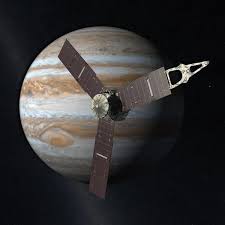
Why NASA Says the Gas Giant is “Much More Complicated” Than Thought
NASA’s Juno Mission: Rewriting the Story of Jupiter
On May 12, 2026, Universe Today reported on a major press conference held at the European Geosciences Union (EGU) 2026 General Assembly in Vienna. Scientific leaders from NASA’s Juno mission revealed that Jupiter’s internal structure and atmospheric dynamics are significantly more complex than any previous model predicted.
The “Dilute Core” Mystery
The most shocking revelation involves Jupiter’s heart. Conventional theory suggested a compact, solid core of rock and ice about 10 times the mass of Earth.
-
The Reality: Principal Investigator Scott Bolton stated that Jupiter actually possesses a “very large, diffuse, dilute core.”
-
The Implications: Instead of a distinct solid ball, the core seems to be “dissolved” or mixed with the surrounding metallic hydrogen. This suggests that during its formation, Jupiter may have had a much more violent or “unstable” beginning than we realized.
-
AI Intervention: The team is now using machine learning and AI to process the gravity data to determine if a tiny, compact “seed” core still exists at the very center.
The “Onion” Interior
Using Juno’s Microwave Radiometer (MWR)—which “sees” through the clouds using six different channels at varying depths—scientists have mapped a planet that is anything but uniform.
-
Not Well Mixed: Yohai Kaspi of the Weizmann Institute noted that Jupiter’s atmosphere is not well-mixed. The data requires scientists to model the planet like an onion with many, many layers.
-
Torqued Orbits: Because Jupiter is not a perfect sphere (it’s an oblate spheroid), its gravity has “torqued” Juno’s orbit over time. The spacecraft is now making its closest approaches over the North Pole, providing a “pole-to-pole” scan that is revealing the deep structure of the planet’s iconic belts and zones.
A Slimmer, Flatter Giant
Adding to the complexity, a study published in Nature Astronomy (May 2026) used Juno’s radio occultation data to provide the most precise measurements of Jupiter in 50 years.
-
The Measurements: The mean radius is now calculated at 69,886 km—about 8 km smaller than previous estimates from the Voyager era.
-
Why it Matters: These few kilometers are crucial for physicists. Shifting the radius allows interior models to finally fit both the observed gravity data and the atmospheric measurements simultaneously.