











Measuring Humanity in a Single Point of Light
Universe Today: The Story of “Four People in a Pixel”
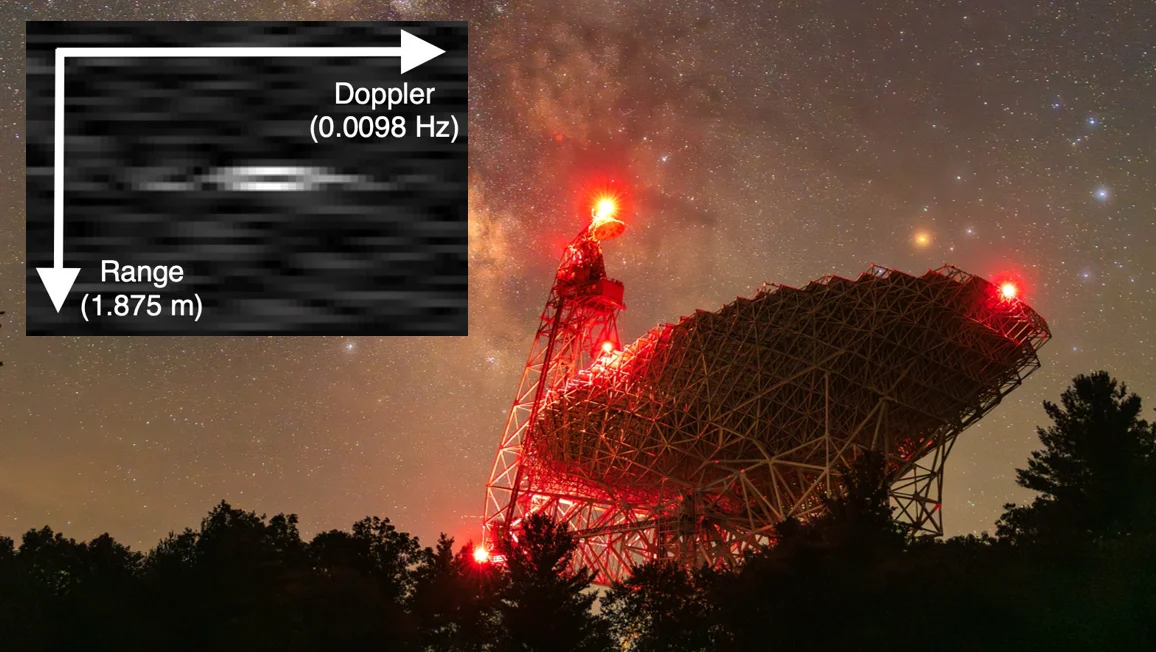
Published on May 13, 2026, by Mark Thompson, the Universe Today article “Four People in a Pixel” captures a profound moment in the Artemis II mission. While the mission’s own cameras were busy capturing high-definition footage of the Moon, the Robert C. Byrd Green Bank Telescope (GBT) in West Virginia was performing a silent, high-precision feat of radio tracking from Earth.
The Feat: Tracking the Orion Capsule
The GBT, which is the world’s largest fully steerable radio telescope (with a dish spanning 2.3 acres), was tasked with monitoring the Orion spacecraft during its historic lunar flyby.
-
Distance: The telescope tracked the craft at its furthest point from Earth—over 343,000 kilometers (213,000 miles) away.
-
Precision: Scientists at the Green Bank Observatory were able to measure Orion’s speed to within 0.2 millimeters per second of NASA’s own calculated trajectory. To put that in perspective, that is a speedometer accurate to within 0.0004 mph.
-
The “Pixel” Moment: In the raw radio data, the spacecraft and its four-person crew—Reid Wiseman, Victor Glover, Christina Koch, and Jeremy Hansen—appeared as just a few scattered, blurry pixels.
Why This Matters: The Future of Deep Space Navigation
This wasn’t just a photo op; it was a critical test of independent navigation verification:
-
Redundancy: By using Earth-based radio telescopes like the GBT, NASA can verify the spacecraft’s onboard GPS and navigation systems using an external, ultra-sensitive source.
-
Quiet Zone Advantage: Located in the National Radio Quiet Zone, the GBT is shielded from the “noise” of modern tech (cell phones, Wi-Fi), allowing it to pick up the incredibly faint “hum” of a spacecraft’s communications from the depths of space.
-
Human Scale: As the article points out, while we often see “pixels” of stars or planets, this was a rare moment where a “pixel” represented actual human lives moving through the void.
The Artemis II Context (May 2026)
The mission, which launched on April 1, 2026, has been a scientific and cultural triumph:
-
First Humans at the Moon in 50 years: The crew has been delivering a “treasure trove” of data, from lunar surface photography to testing IV fluid creation in space.
-
The “Pale Blue Dot” Parallel: The article draws a comparison to Voyager 1’s iconic photo, noting that while Earth was a “pale blue dot” in 1990, in 2026, we have a “pixel” that we can actually talk to in real-time.