










ESA and JAXA Sign Historic Deal for Apophis Mission
ESA and JAXA Team Up: The Ramses Mission to Apophis
On May 7, 2026, the European Space Agency (ESA) and the Japan Aerospace Exploration Agency (JAXA) finalized a landmark agreement to collaborate on the Rapid Apophis Mission for Space Safety (Ramses). The signing ceremony took place at the Italian Embassy in Berlin, shifting the project from a shared vision into a concrete, mission-level implementation.
The Mission: A Once-in-a-Lifetime Opportunity
The target is (99942) Apophis, a 375-meter asteroid (roughly the size of the Eiffel Tower). On April 13, 2029, it will pass just 32,000 km from Earth—closer than many telecommunications satellites.
-
The “Natural Experiment”: While there is no risk of impact, Earth’s gravity will physically reshape Apophis. Scientists expect to witness landslides, surface tremors, and changes in the asteroid’s spin.
-
The Timeline: Ramses must launch in April 2028 to arrive at the asteroid in February 2029—two months before the flyby. This allows the probe to capture “before and after” data of the asteroid’s transformation.
International Cooperation: Who is Building What?
This partnership leverages the unique technical strengths of both agencies:
-
ESA’s Role: Leading mission operations, spacecraft design, and integration. Italy’s OHB Italia has been selected as the prime contractor.
-
JAXA’s Contribution: Providing the H3 launch vehicle for a 2028 lift-off from Tanegashima, along with lightweight solar arrays and a Thermal Infrared Imager (TIRI) to map the asteroid’s heat signature.
-
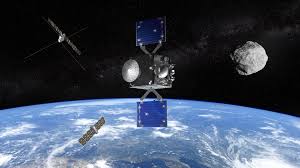
The “Cubesat” Escorts: Ramses will carry two miniature satellites. One, named Farinella, will study the interior via radar, while another will attempt to land on the surface to measure seismic waves.
Planetary Defense Strategy
At zyproo.online, we analyze the technical significance of this mission. It isn’t just about science; it’s a “dry run” for a real threat:
-
Rapid Response: Ramses demonstrates that humanity can deploy a reconnaissance mission in just a few years—a crucial skill if a truly hazardous object is ever discovered.
-
Structural Data: Knowing whether an asteroid is a “solid monolith” or a “loose rubble pile” is essential for determining if future deflection missions (like NASA’s DART) would work.