











Your 2026 Guide to the Lunar Calendar
Lunar Cycles: Navigating the Phases of the Moon in May 2026
The Moon is Earth’s only natural satellite, and its constant dance around our planet creates the familiar cycle of phases we see from our backyards. As of May 10, 2026, we are currently transitioning from the Third Quarter into the New Moon phase. May is a particularly special month for skywatchers, featuring a rare “double” Full Moon.
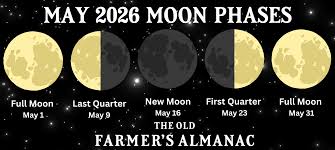
The May 2026 Lunar Calendar
May 2026 is a unique month in the lunar cycle, containing two Full Moons—the second of which is colloquially known as a Blue Moon.
| Phase | Date (2026) | Significance |
| Full Moon | May 1 | Known as the Flower Moon, marking the spring bloom. |
| Last Quarter | May 9–10 | The Moon is half-lit on the left side, visible in the early morning. |
| New Moon | May 16 | A Super New Moon—the Moon is closest to Earth but invisible. |
| First Quarter | May 23 | Half-lit on the right side; the best time to see crater shadows. |
| Full Moon | May 31 | A Blue Moon and a Micro Moon (farthest from Earth). |
Understanding the Eight Phases
At zyproo.online, we love breaking down the science behind the scenery. The Moon doesn’t actually change size or shape; what we see is the changing angle of sunlight reflecting off its surface as it orbits Earth.
-
New Moon: The Moon is between Earth and the Sun. The side facing us is dark.
-
Waxing Crescent: A thin sliver of light appears on the right side as the Moon moves away from the Sun.
-
First Quarter: One week after the New Moon, we see half the Moon illuminated.
-
Waxing Gibbous: “Gibbous” means humped. Most of the Moon is lit, but it’s not quite full.
-
Full Moon: Earth is between the Sun and Moon. The entire Earth-facing side is lit.
-
Waning Gibbous: The light begins to “shrink” from the right side.
-
Third (Last) Quarter: The opposite of the First Quarter; the left half is lit.
-
Waning Crescent: The final sliver before the cycle restarts.
2026 Special Events: The Blue Micro Moon
The Full Moon on May 31, 2026, is a double-rarity:
-
Blue Moon: It is the second Full Moon in a single calendar month. This happens roughly every 2.5 to 3 years.
-
Micro Moon: It occurs while the Moon is at apogee (its farthest point from Earth). It will appear about 14% smaller and slightly dimmer than a “Supermoon.”
Skywatching Tips for May
-
May 14: Look for the waning crescent Moon sitting just 7° away from Mars in the pre-dawn sky.
-
May 18-19: Shortly after sunset, look to the western horizon to see a skinny waxing crescent Moon hanging next to a brilliant Venus.
-
The “Terminator” Line: If you have binoculars, the best time to look at the Moon isn’t during a Full Moon, but during the First Quarter (May 23). The shadows along the “terminator” (the line between light and dark) make the craters and mountains pop with 3D-like detail.
Whether you’re tracking the tides or just enjoying the view, May 2026 is one of the most active months for the Moon this decade.