










Underwater Radars: How Harbor Seals Use Whiskers to Track the Invisible
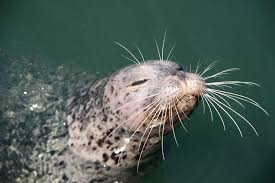
In an fascinating report by NPR’s Ari Daniel on April 16, 2026, scientists have unveiled the high-tech secret behind the hunting prowess of harbor seals. It turns out that a seal’s whiskers—roughly 100 per animal—are not just for show; they are sophisticated sensory arrays that allow them to “see” underwater trails even in total darkness or the murkiest conditions.
This biological “radar” is so precise that seals can track a single fish purely by the vibrations it left behind over half a minute ago.
The “Airplane Wake” of the Ocean
Just as an airplane leaves a visible wake of disturbed air behind it, a swimming fish leaves behind a series of underwater “smoke rings” known as vortex rings.
-
Persistent Trails: These hydrodynamic trails can last for several seconds. Research shows that seals can detect a trail up to 35 seconds after a fish has passed—a time during which a fish might have already covered hundreds of meters.
-
Sensitive Sensors: Each whisker is packed with nerves—ten times more than a typical mammal’s facial hair—making them sensitive enough to detect tiny changes in water movement as small as the width of a human thumb.
The Case of “Filou” the Nerd
To test these abilities, biologist Yvonne Krüger from the University of Rostock worked with an adult male harbor seal named Filou.
-
The Deception Test: Some fish, like the rainbow trout, try to “camouflage” their escape by bending their bodies to spin off multiple vortex rings in different directions to confuse predators.
-
The Result: Filou was trained to differentiate between these rings. Even when the rings were almost identical in size, he could identify the correct “bigger” ring—the one indicating the fish’s true escape path—with over 80% accuracy.
-
Proof in the Stocking: When researchers covered Filou’s whiskers with a nylon stocking, he immediately lost the ability to track the prey, confirming that his whiskers, not his eyes or ears, were the primary tool for the task.
Engineering the Future
The specialized wavy shape of a seal’s whiskers is a masterclass in evolution. This unique geometry allows the whiskers to remain perfectly still while the seal is swimming, ensuring they only vibrate in response to external turbulence rather than the seal’s own movement.
Engineers are now looking at this “whisker logic” to develop:
-
Underwater Robots: Creating bio-inspired sensors for autonomous vehicles to navigate and survey polluted or dark waters.
-
Tracking Systems: Helping marine biologists track schools of fish or monitor environmental changes without invasive technology.