











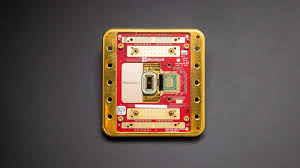
The New “Flying Qubit” Technology That Could Finally Kill Classic Computers
Quantum Mobility: Scientists Unlock the Power of Moving Qubits
The race to build a truly functional quantum supercomputer has hit a massive bottleneck: locality. In traditional quantum chips, qubits (quantum bits) are stationary, meaning they can only interact with their immediate neighbors. However, a groundbreaking report from Ars Technica reveals that researchers have successfully manufactured qubits capable of “moving” across a chip without losing their delicate quantum state.
The Science: Breaking the “Static” Barrier
In standard quantum architecture, connecting distant qubits requires a complex web of “couplers” that often introduce noise and errors. The new breakthrough utilizes a technique where qubits—specifically those made from trapped ions or superconducting circuits—are physically transported across the processor using electromagnetic “conveyor belts.”
By creating Mobile Qubits, scientists can now bring two distant pieces of data together, perform a calculation, and move them back. This eliminates the need for massive, cluttered wiring and allows for a much more scalable “modular” quantum computer.
The Manufacturing Shift: Precision at the Atomic Scale
What makes this vital for the zyproo.online tech community is the manufacturing achievement. Moving a qubit is like trying to carry a drop of water on a needle while running through a hurricane; the slightest vibration can cause “decoherence,” destroying the data.
The researchers achieved this by:
-
Nanoscale Waveguides: Specialized tracks that guide the qubits with 99.9% precision.
-
Ultrafast Shuttling: Moving the bits so quickly that the external environment doesn’t have time to interfere with their quantum “spin.”
Why This Changes Everything for AI and Cryptography
The ability to move qubits means we can finally build large-scale quantum processors. Current chips are limited to dozens or hundreds of qubits because of the wiring mess. With mobile qubits, we can link thousands of processors together into a single “Quantum Internet.”
This leap in connectivity will drastically accelerate the development of:
-
Ultra-Secure Encryption: Creating codes that are physically impossible to hack.
-
Molecular Simulation: Designing new medicines by simulating atoms in real-time.
-
Advanced AI: Training models that are millions of times more powerful than today’s GPT systems.