











The “Decapitated” Asteroid: Unraveling the Mystery of the Moon’s Largest Impact Crater
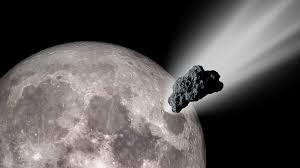
The history of our solar system is written in scars, and the largest one on the Moon may have been caused by a “bizarre, decapitated” asteroid. As reported by Space.com on May 8, 2026, new geological modeling suggests that the South Pole-Aitken (SPA) Basin—a massive 1,600-mile-wide crater—was formed by a low-angle, “grazing” impact. This theory not only reshapes our understanding of lunar history but also provides a specific mission objective for NASA’s Artemis astronauts.
1. The “Decapitated” Impact Theory
Traditional craters are formed by objects striking a surface head-on, but the SPA Basin is different.
-
The Grazing Strike: Researchers believe a massive asteroid struck the Moon at a very shallow angle. During the collision, the top portion of the asteroid—the “head”—was sheared off and sent back into space, while the “body” was swallowed by the Moon.
-
The Result: This “decapitation” explains why the basin is uniquely elongated and why the impact was powerful enough to peel back the lunar crust, exposing the mantle (the layer beneath the surface) without shattering the entire Moon.
2. Artemis: Landing on the Proof
This isn’t just a theoretical mystery; it is a roadmap for the next generation of lunar explorers.
-
NASA’s Target: The Artemis III and IV landing sites are located near the southern rim of this basin.
-
The “Holy Grail” of Samples: If the theory is correct, the rocks at the lunar South Pole are not typical surface dust. They likely contain exposed mantle material, providing a direct look at the interior of a planetary body for the first time in human history.
-
Astronaut Tasks: Artemis crews will be looking for specific mineral signatures, such as pyroxene and olivine, which would confirm that the impact was deep enough to “excavate” the Moon’s inner layers.
3. Why the SPA Basin Matters
The South Pole-Aitken Basin is one of the most significant features in the solar system for two reasons:
-
The Time Machine: It is the oldest known impact site on the Moon. Dating the rocks here will tell scientists exactly when the “Late Heavy Bombardment” occurred, a period when the early Earth was also being pummeled by space debris.
-
Resource Potential: The deep shadows within the basin’s smaller, secondary craters (like Shackleton) are known to host water ice, which is essential for sustainable human life on the Moon.
4. Scientific Consensus and Controversy
While the “decapitated asteroid” model explains the basin’s odd shape, some scientists still argue for a slower-moving, larger body that simply melted into the crust.
-
The Verdict: We won’t know for certain until a human or robot physically returns a sample from the basin floor. This makes the upcoming Artemis missions the most scientifically significant voyages since the Apollo era.