











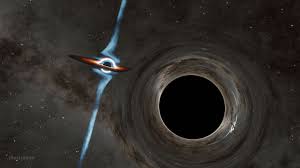
Echoes of Giants: How Spacetime Ripples are Unlocking the Secrets of Supermassive Black Holes
The mystery of how the universe’s most gargantuan objects came to be is finally coming into focus. As reported by Space.com on May 8, 2026, astronomers are using a “celestial choir” of gravitational waves to trace the origins of supermassive black holes—monsters that hold millions or even billions of times the mass of our sun.
1. The “Background Hum” of the Universe
For years, scientists have detected sharp, quick gravitational waves from small black hole collisions. However, the biggest black holes move too slowly for traditional detectors.
-
Pulsar Timing Arrays (PTAs): To find the “big ones,” scientists are using pulsars—dead stars that spin with the precision of atomic clocks. By monitoring subtle delays in their pulses, researchers have detected a “gravitational wave background.”
-
The “Slow Dance”: This low-frequency hum is created by pairs of supermassive black holes circling each other in distant galaxies, like a cosmic bass note that vibrates through the fabric of reality.
2. Solving the “Final Parsec” Problem
A major hurdle in black hole theory has been the “Final Parsec Problem”—the idea that once two massive black holes get close, they might stall and never actually collide.
-
The Clue: The strength and frequency of the ripples recently detected suggest that these giants do find a way to merge.
-
The Catalyst: Evidence points to gas and stars acting as “friction,” dragging the black holes together across those final few light-years until gravity takes over and they snap into a single, larger entity.
3. Seeds from the Dawn of Time
One of the most exciting takeaways from this data is the “Heavy Seed” vs. “Light Seed” debate.
-
Light Seeds: These would be black holes formed from the collapse of the very first stars.
-
Heavy Seeds: These are formed by the direct collapse of massive gas clouds in the early universe, skipping the “star” phase entirely.
-
The Current Verdict: The ripples suggest that supermassive black holes grew much faster than expected, supporting the theory that “Heavy Seeds” gave them a massive head start just after the Big Bang.
4. What This Means for Future Astronomy
This discovery marks the beginning of “Multi-Messenger Astronomy” for the largest objects in existence.
-
LISA Mission: NASA and the ESA are preparing the Laser Interferometer Space Antenna (LISA), a space-based observatory that will sit millions of miles apart to “hear” these supermassive collisions with perfect clarity.
-
Mapping Galactic Growth: By studying these ripples, we are essentially building a family tree of galaxies, seeing how every major galaxy (including our own Milky Way) was shaped by the mergers of its central black holes.