











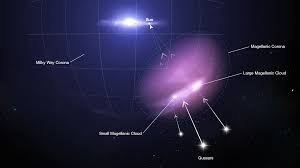
The Great Space Mystery: Is the Large Magellanic Cloud a First-Time Visitor to Our Galaxy?
One of our closest and most massive galactic neighbors, the Large Magellanic Cloud (LMC), is currently at the center of a heated scientific debate. Astronomers are trying to determine if this giant cluster of stars is a long-time companion of the Milky Way or a “first-time visitor” just passing through our neighborhood for the first time in cosmic history.
New research published in May 2026 provides compelling evidence that the LMC might be a newcomer, a finding that completely changes how we understand the evolution of our own galaxy.
The “First Pass” vs. “Second Pass” Debate
For years, it was assumed that the LMC was a permanent satellite orbiting the Milky Way. However, recent data has split the scientific community into two camps:
-
The Second-Pass Theory: Some models suggest the LMC first passed the Milky Way 6 to 8 billion years ago at a distance of about 100 kiloparsecs. This theory relies on the idea that our galaxy’s dark matter is “anisotropic,” or skewed in specific directions.
-
The First-Pass Theory: New simulations using GIZMO software have reproduced the LMC’s current velocity and gas density profiles perfectly by assuming it has never encountered the Milky Way before now.
The Evidence: A “Corona” Under Pressure
The strongest piece of evidence for the “First-Pass” theory involves the LMC’s corona—the massive halo of warm, ionized gas that surrounds the galaxy.
-
Gas Stripping: When a galaxy “swims” through the dense gas of the Milky Way, its own outer gas is stripped away.
-
The Result: The LMC still has a massive, healthy corona. If it had passed by us billions of years ago, that gas would have been shredded away long ago. Its current size suggests it is only just now beginning to feel the pressure of the Milky Way’s environment.
A Chaotic History of Collisions
While the LMC’s relationship with the Milky Way is debated, its relationship with its smaller neighbor, the Small Magellanic Cloud (SMC), is much clearer. Recent studies show that a few hundred million years ago, the SMC crashed directly through the disk of the LMC.
-
The Impact: This catastrophic crash scrambled the stars in the SMC and tilted the central “bar” of the LMC.
-
The Aftermath: This collision is likely what triggered the sudden “star-formation boom” we see in both galaxies today, as gas was compressed and ignited into new stellar nurseries.
Why It Matters for Our Future
If the LMC is a first-time visitor, it means it is a massive, “fresh” system entering our space. Its immense gravity is already warping the outer edges of the Milky Way. Understanding its orbit helps astronomers predict the eventual merger of these two systems—a cosmic event that will fundamentally reshape our night sky in the billions of years to come.