











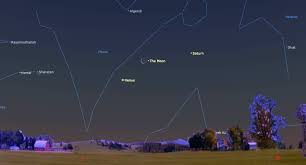
The May 2026 Planetary Sky Show: Venus, Jupiter, and Mercury
According to Space.com, the month of May 2026 offers a rare celestial transition. While we lose some of the giant planets to the sun’s glare, the evening sky is being taken over by a “three-planet display” featuring Venus, Jupiter, and Mercury.
1. The Three Main Acts
-
Venus (The Evening Star): Dominating the west-northwest throughout May, Venus is the brightest object in the sky (magnitude -4.0). It remains a brilliant white beacon that is impossible to miss after sunset.
-
Jupiter (The Final Curtain): This is your last chance for several months to get a crisp telescopic view of the gas giant. It is currently in the constellation Gemini, about one-third of the way up the western sky at dusk, but it is sinking lower each night.
-
Mercury (The Speedy Ghost): After being hidden behind the sun (superior conjunction) on May 14, Mercury re-emerges in the evening sky by May 22. By the end of May, it will be a clear “naked-eye” object, sitting about 10 degrees above the western horizon 45 minutes after sunset.
2. Key Dates to Mark in Your Diary
The “Sky Show” peaks during several high-visibility pairings with the moon
| Date | Event | What to Look For |
| May 13 | Moon & Saturn | Early morning (dawn) view of a crescent moon just 6° from the ringed planet. |
| May 14 | Moon & Mars | A very thin 8% moon sliver helps you find the dim Red Planet in the bright morning twilight. |
| May 18 | The Venus Meetup | A slender crescent moon sits just 2.5° to the right of brilliant Venus in the evening. |
| May 19 | The Three-Planet Line | The moon shifts to sit perfectly between Jupiter and Venus, creating a stunning straight-line alignment across the twilight sky. |
| May 20 | Moon & Jupiter | The moon moves within 7° of Jupiter. Look for the star Pollux nearby, forming a cosmic triangle. |