











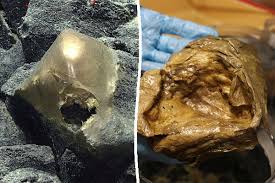
Solved: The Deep-Sea “Golden Orb” Mystery
After nearly three years of scientific investigation, the mysterious “Golden Orb” discovered two miles deep in the Gulf of Alaska has finally been identified. While the internet buzzed with theories of alien eggs or new species of prehistoric fish, a study published in April 2026 confirms a far more biological—yet equally fascinating—origin.
1. The Identity: A “Biological Hand-Me-Down”
Scientists from NOAA and the Smithsonian National Museum of Natural History have concluded that the orb is not a living organism itself, but a remnant cuticle (a protective outer layer) from a giant deep-sea anemone called Relicanthus daphneae.
-
The Function: This golden, fleshy mass was the base of the anemone—the part that anchors the massive animal to the rocky seafloor.
-
The Discovery: The “orb” was likely left behind when the anemone either died or detached itself to move to a new location, leaving its durable, golden-colored “skin” behind like a discarded shell.
2. How the Mystery Was Cracked
The identification was a multi-year effort because the specimen lacked typical animal anatomy (no mouth, gut, or muscles). Researchers had to use high-tech “detective” methods:
-
Microscopy: Under a microscope, scientists found the surface was packed with spirocysts—specialized stinging cells unique to a group called Hexacorallia (which includes anemones and corals).
-
DNA Sequencing: Initial DNA tests were inconclusive because the orb had become a “micro-ecosystem” for deep-sea bacteria. However, whole-genome sequencing in early 2026 revealed a near-perfect match to the mitochondrial DNA of Relicanthus daphneae.
-
The “Golden” Connection: Researchers eventually found a live Relicanthus specimen in the Southern Ocean that had a similar golden, fibrous base, providing the final visual link.
3. Meet the “Owner”: Relicanthus daphneae
This isn’t your typical garden-variety anemone. Relicanthus daphneae is a giant of the deep:
-
Size: Its body can grow up to 12 inches (30 cm) across, with long, pinkish-purple tentacles that can stretch over 7 feet (2 meters).
-
Habitat: It lives in total darkness at depths between 4,000 and 13,000 feet, often perching on rocks to catch passing prey.
-
Classification: It is so unique that scientists are still debating its classification; while it looks like an anemone, genetic studies suggest it belongs to a distinct, ancient lineage of cnidarians.
4. Summary of the Investigation
| Feature | Initial Theory | 2026 Fact |
| Origin | Alien Egg / New Sponge | Anemone Base (Cuticle) |
| Color | Headlight Reflection | Natural Golden Pigment |
| The “Hole” | Hatching Exit Point | Tear from Detachment |
| Scientific Name | Unknown | Relicanthus daphneae |