










Rising Time Capsules: The Tectonic Secret of Australia’s Twelve Apostles
A study published in the Australian Journal of Earth Sciences in late April 2026 has finally settled the debate over how the Twelve Apostles formed. Led by Associate Professor Stephen Gallagher from the University of Melbourne, the research reveals that these iconic stacks are much more than just the result of coastal erosion—they are “rising time capsules” pushed up from the ocean floor.
1. The New Timeline: Younger Than We Thought
For years, the age of the Apostles was estimated broadly between 7 and 15 million years. Using high-resolution digital mapping and microscopic fossil analysis of foraminifera (tiny sea creatures), scientists have provided a precise new window:
-
The Rocks: The limestone layers themselves are between 8.6 and 14 million years old.
-
The Stacks: While the rock is ancient, the actual “Twelve Apostles” pillars we see today are “brand new” in geological terms—forming only within the last several thousand years.
2. The “Mystery” Solved: Tectonic Uplift
The biggest discovery is that the Apostles didn’t just sit there while the ocean ate away at the land. They were actively pushed out of the sea.
-
Plate Tectonics: As the Australian plate drifted northward toward Asia, the resulting compression in the Earth’s crust squeezed and buckled the region starting around 8.6 million years ago.
-
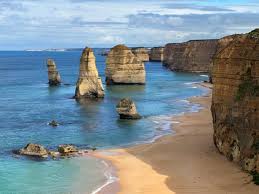
The Tilt: If you look closely at the cliffs, you’ll notice the horizontal layers aren’t perfectly flat—they are tilted by a few degrees. These are “scars” of ancient earthquakes that forced the limestone upward.
-
The Foundation: The stacks sit on a base of Gellibrand Marl (a soft, dark clay) which was deposited in deeper, warmer seas 15 million years ago before being topped by the brittle Port Campbell Limestone.
3. From Mainland to Sea Stacks: The 4-Stage Process
The study clarifies how the modern structures emerged after the last Ice Age (approx. 20,000 years ago) as sea levels rose nearly 125 meters:
| Stage | Process | Result |
| 1. Cracking | Waves attack tectonic fault lines in the limestone. | Narrow fissures/cracks. |
| 2. Caves | Relentless Southern Ocean swells hollow out the fissures. | Deep Sea Caves. |
| 3. Arches | Erosion breaks through the back of the caves. | Dramatic Arches (like London Bridge). |
| 4. Stacks | The weight of the arch becomes too great and collapses. | Isolated Pillars (The Apostles). |
4. A Window into Future Climate
Because the Apostles are so well-preserved, they act as an “environmental time capsule.” The layers from 13.8 million years ago represent a period when Earth’s climate was naturally much warmer than today. By studying these layers, scientists are using the Apostles to predict how modern sea levels might react to our current warming trend.