











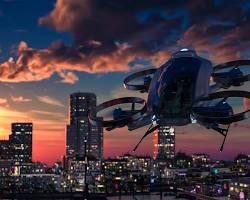
The Future of Urban Mobility: Flying Taxis and the AI Revolution
As cities continue to swell in size and density, the “gridlock problem” has shifted from a nuisance to a major economic barrier. The latest reports from tech summits, including recent updates discussed by global leaders, suggest that the era of the flying taxi is no longer relegated to science fiction. We are entering a pivotal phase where Artificial Intelligence (AI) and eVTOL (electric vertical take-off and landing) aircraft are converging to reshape how we navigate our world.
1. The eVTOL Breakthrough
Unlike traditional helicopters, eVTOLs are designed for the urban environment.
-
Silence and Safety: These aircraft use multiple small electric rotors, making them significantly quieter than helicopters—a necessity for operating over residential neighborhoods.
-
The “Uber of the Skies”: Several companies are already testing “vertiport” infrastructures, aiming to turn rooftop helipads into transit hubs where commuters can hail a flight via a smartphone app.
2. AI: The Invisible Pilot
The most significant hurdle for mass urban flight isn’t just the hardware; it’s the traffic control. This is where AI steps in.
-
Autonomous Navigation: Future air taxis are designed to be pilotless. AI systems handle millisecond-level adjustments to weather changes and obstacle avoidance.
-
Fleet Management: Sophisticated algorithms will coordinate thousands of flights simultaneously, ensuring that flight paths never intersect—a feat impossible for human air traffic controllers at high volumes.
3. Sustainability and the “Green” Airway
The push for air mobility is deeply tied to the global effort to decarbonize transportation.
-
Zero Emissions: By running entirely on electric power, these vehicles offer a zero-emission alternative to gasoline-powered cars sitting in idle traffic.
-
Reduced Infrastructure: Building “highways in the sky” requires far less physical infrastructure and environmental disruption than digging tunnels or expanding multi-lane freeways.
4. Challenges on the Horizon
Despite the excitement, several “anchors” remain:
-
Regulation: Aviation authorities are currently developing entirely new frameworks for “Urban Air Mobility” (UAM) to ensure these vehicles meet the same rigorous safety standards as commercial jets.
-
Public Perception: Concerns regarding noise, privacy, and safety mean that widespread adoption will depend heavily on building public trust through transparent testing phases.
Why This Matters Now
With major tech players and governments increasing their investments in AI and green tech this year, the dream of soaring over traffic is becoming a commercial reality. We are witnessing a shift from “mobile-first” to “mobility-first,” where the goal is to give people back the hours they currently lose to the commute.