











The Missing Piece: Can Quantum Gravity Reveal the Secret of the Big Bang?
For decades, the world of physics has been divided. On one side, we have General Relativity, which explains the vast world of stars and galaxies. On the other, we have Quantum Mechanics, which governs the tiny world of atoms. Now, scientists believe the bridge between them—a theory called Quantum Gravity—could finally explain exactly how our universe began.
The Great Physics Divide
Think of our current understanding of the universe like two different rulebooks that don’t talk to each other.
-
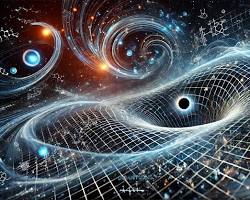
Gravity’s Rulebook: Explains how massive objects warp space and time, like a bowling ball on a trampoline.
-
The Quantum Rulebook: Explains a world where things can be in two places at once and nothing is certain until it’s measured.
The problem? At the very moment of the Big Bang, the entire universe was both incredibly massive and incredibly tiny. To understand that moment, we need a single set of rules: Quantum Gravity.
Peering Into the “Singularity”
Standard math tells us that the universe started as a “singularity”—a point of infinite density where time and space break down. Most physicists, however, don’t believe “infinity” actually exists in nature. They suspect that if we apply quantum gravity, the “point” at the beginning of time wasn’t a dead end, but a transition.
Some theories suggest the universe didn’t start from nothing, but rather “bounced” from a previous state, or that space-time itself is made of tiny, discrete “atoms” of geometry that prevent everything from collapsing into nothingness.
Why It Matters for Our Future
Cracking the code of Quantum Gravity isn’t just about looking backward. Understanding how gravity works at a microscopic level could unlock:
-
Black Hole Secrets: We could finally understand what happens at the center of a black hole without the math breaking.
-
New Energy Concepts: Deep insights into the fabric of space-time could eventually lead to revolutionary ways of thinking about propulsion or energy.
-
A “Theory of Everything”: It would be the ultimate achievement in science—a single equation that explains every physical phenomenon in the cosmos.
The Search Continues
Since we can’t recreate a Big Bang in a lab, researchers are looking for “ghosts” of quantum gravity in the cosmic microwave background (the afterglow of the Big Bang) or by studying the gravitational waves emitted by colliding black holes. We are closer than ever to reading the first page of the universe’s history book.