











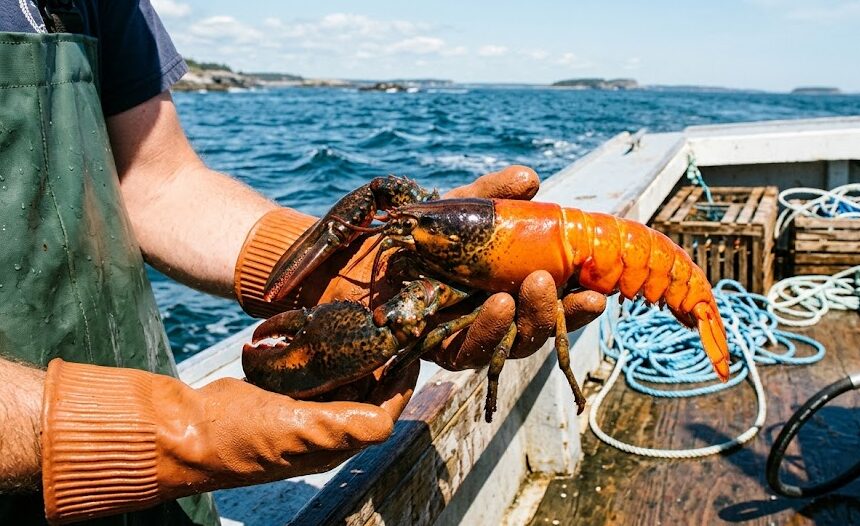
One in 50 Million: Rare Two-Colored Lobster Donated to Aquarium
In an incredible stroke of luck, a group of fishermen off the coast of Cape Cod caught a rare “half-and-half” lobster that is estimated to be a one-in-50-million find. The crustacean, which features a near-perfect line dividing its body into two distinct colors, has been donated to a local aquarium to ensure its survival and to educate the public on genetic rarities.
A Genetic Marvel
This unique specimen is a biological anomaly that has fascinated researchers and locals alike:
-
Split Coloring: The lobster is perfectly split down the middle, with one side being a traditional dark mottled brown and the other a bright orange.
-
The Odds: Marine biologists estimate the chance of finding a bi-colored lobster at approximately 1 in 50 million, making it significantly rarer than blue or even calico lobsters.
-
Bilateral Gynandromorphy: While not yet confirmed for this specific lobster, many “half-and-half” lobsters are bilateral gynandromorphs—meaning they are literally half-male and half-female, split right down the center.
Safe Harbor at the Aquarium
Recognizing the scientific value of the catch, the fishermen decided against sending it to a dinner plate:
-
The Donation: The lobster was donated to a New England aquarium, where it will live in a protected environment away from predators.
-
Public Education: The aquarium plans to put the lobster on display, allowing visitors to see the rare genetic mutation firsthand.
-
Research Opportunities: Scientists hope to study the lobster to learn more about how these distinct color pigments develop during the creature’s growth cycle.
Rare Color Variations in Lobsters
While most lobsters are brownish-green, rare genetic mutations can result in several striking colors:
-
Blue Lobsters: 1 in 2 million.
-
Calico/Mottled Lobsters: 1 in 30 million.
-
Two-Colored/Split Lobsters: 1 in 50 million.
-
Albino/White Lobsters: 1 in 100 million.