











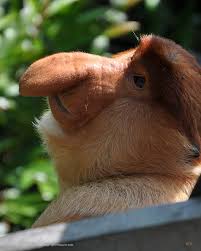
The Proboscis Monkey: Why Borneo’s “Supersized Schnoz” Is a Survival Tool
In the April/May 2026 issue of Smithsonian Magazine, writer Alex Fox and photographer Roberto García-Roa take us deep into the mangroves of Borneo to visit one of the world’s most unique primates: the Proboscis Monkey. While their massive, floppy noses have made them a target of internet memes, new research shows that these “schnozzes” are actually high-tech biological instruments.
1. The Science of the Snout: Bigger is Better
For a male proboscis monkey, a nose isn’t just for breathing—it’s a visual and acoustic “badge” of health and social rank.
-
The Mating Signal: Males with the largest noses (reaching up to 7 inches) attract more females. The nose serves as an “honest signal” of physical fitness and high testosterone.
-
The Echo Chamber: A large nose acts as a specialized resonating chamber. It allows males to emit loud, deep “honks” and “nasal roars” that can travel through dense jungle foliage to warn off rivals or call to their harem.
-
The Health Badge: Curiously, researchers found that while nose size is positively correlated with body and testis size, it is negatively correlated with canine size. This suggests the monkeys have traded physical weapons (teeth) for social ornaments (noses) to settle disputes without fighting.
2. The Aquatic Primate: Webbed Toes & Crocodiles
Found only on the island of Borneo, these monkeys have adapted to a lifestyle at the water’s edge unlike almost any other primate.
-
Swimming Champions: They are arguably the most aquatic primates on Earth. They have partially webbed fingers and toes that help them paddle across rivers.
-
The Belly Dive: They are known to jump from heights of up to 50 feet into the water, belly-flopping to cross rivers as quickly as possible to avoid the crocodiles that patrol the waterways.
-
Safety in the Canopy: At night, they sleep in trees directly over the water. This is a tactical defense; if a clouded leopard tries to sneak up on them, the monkeys can simply drop into the water and swim to safety.
3. The Conservation Fight (2026 Status)
Despite being a flagship species for Borneo, the proboscis monkey remains Endangered due to its extreme habitat specificity.
-
Shrinking Homes: Because they rely on coastal mangroves and riverine forests, they are the first to suffer when land is cleared for oil palm plantations.
-
Restoration Efforts: The Malaysian group Hutan has planted over 246,000 native trees since 2008 to rebuild “forest corridors.”
-
The Population Count: Current estimates suggest there are only 20,000 to 25,000 individuals left in the wild.
Proboscis Monkey Vital Stats
| Feature | Detail |
| Scientific Name | Nasalis larvatus |
| Nose Length | Up to 10 cm+ (Males) |
| Birth Mark | Babies are born with bright blue faces. |
| Diet | Strictly folivores (unripe fruit and young leaves). |
| Habitat | Mangroves of Indonesia, Malaysia, and Brunei. |