











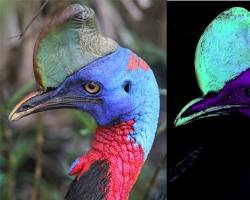
Hidden Radiance: Why the World’s Most Dangerous Bird Glows Under UV Light
For decades, the cassowary has been feared for its dagger-like claws and “dinosaur” appearance. But recent research, highlighted by National Geographic in April 2026, has revealed a hidden, magical side to these formidable birds: they glow vibrantly under ultraviolet (UV) light. This discovery is more than just a visual “glow-up”—it’s a window into how these birds communicate in the deep, dark rainforests of Australia and New Guinea.
1. The Discovery: A Gasp in the Dark
The phenomenon was first documented by Todd Green, an anatomist and paleontologist, who used a UV flashlight on a southern cassowary named Ginger.
-
The Casque Glow: The large, bony structure on the cassowary’s head—the casque—is covered in keratin (the same protein in your hair and nails). Under UV light, this dull-looking “helmet” bursts into a brilliant blue-green fluorescence.
-
A First for Flightless Birds: While UV fluorescence is common in scorpions and some parrots, this is the first time it has been documented in large, flightless birds like the cassowary.
2. Species-Specific “Fingerprints”
One of the most fascinating findings is that the glow isn’t uniform; it serves as a distinct identification tool.
-
Southern & Northern Cassowaries: Both species exhibit bright, complex patterns of fluorescence across their casques.
-
Dwarf Cassowaries: Interestingly, the dwarf cassowary’s jet-black casque does not fluoresce at all, suggesting the glow is tied to specific pigments found in its larger cousins.
-
Taxonomic Tool: This “hidden signature” could help scientists and museum curators identify different species and age groups more accurately than ever before.
3. Why Glow? The Secret Language of Birds
Scientists believe this biofluorescence isn’t just an anatomical accident; it likely serves a functional purpose in the wild.
-
Visual Signaling: Most birds can see UV wavelengths that are invisible to humans. In the dim, green-tinged light of a rainforest canopy, a glowing blue casque would act like a “neon sign,” helping birds find mates or identify rivals from a distance.
-
Maturity Markers: The casque grows and changes as a bird ages. The intensity or pattern of the glow might signal to other cassowaries that a bird has reached sexual maturity and is ready to breed.
4. Conservation and Future Research
Beyond the “cool factor,” this discovery has major implications for protecting these endangered giants.
-
Tracking in the Wild: UV-sensitive cameras could be used to census cassowary populations in the field, making it easier to spot these naturally shy birds in dense foliage.
-
Museum Cataloging: Researchers found that even 100-year-old museum specimens still glow vibrantly, allowing for new insights into historical populations.
5. Myth-Busting: The “Velociraptor” with a Soft Side
While their glow is ethereal, it’s important to remember that cassowaries are critical “gardeners” of the rainforest.
-
The Symbiotic Gardener: Many rare tropical trees rely entirely on cassowaries to eat their fruit and disperse their seeds. Without these “glowing” giants, many parts of the Australian rainforest would simply cease to grow.