









Beyond the Spacesuit: Surprising Realities of Becoming a NASA Astronaut
The dream of reaching the stars is a common one, but the path to becoming a NASA astronaut is far more rigorous—and occasionally more bizarre—than most people realize. Space.com pulls back the curtain on the selection process, revealing that while “The Right Stuff” still involves bravery and intelligence, it also requires a high tolerance for swimming in flight suits and a very specific height.
The Odds are Against You
To say it is difficult to get in is an understatement. In 2016, NASA received over 18,300 applications for a single class; only a handful of individuals were selected. Statistically, it is roughly 74 times harder to become an astronaut than it is to get into Harvard University.
Surprising Requirements
While you don’t need to be a fighter pilot anymore (though it helps), there are several physical and logistical hurdles:
-
The Height Rule: You must be between 5’2″ and 6’3″ (157 to 190 cm). If you are too short, you can’t reach the controls; if you are too tall, you simply won’t fit in the spacecraft.
-
Swimming Skills: All candidates must pass a grueling swimming test in the first month of training. This includes swimming 3 lengths of a 25-meter pool without stopping, followed by swimming the same distance in a full flight suit and tennis shoes.
-
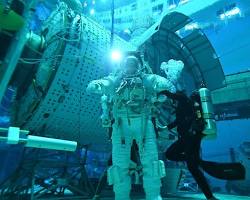
Scuba Certification: Astronauts spend a significant portion of their training underwater in the Neutral Buoyancy Lab to simulate the weightlessness of space.
The “Classroom” is Everywhere
Training doesn’t just happen in a simulator. Astronaut candidates are sent to some of the most extreme environments on Earth:
-
Caving: NASA often sends trainees into deep cave systems to practice teamwork and isolation in “alien” environments.
-
The “Vomit Comet”: To get used to microgravity, trainees fly in a specialized aircraft that performs parabolic arcs, creating 20-30 seconds of weightlessness at a time (and often inducing intense nausea).
It’s a Team Sport
Perhaps the most surprising fact is that NASA isn’t just looking for “superheroes.” They prioritize Expeditionary Skills—qualities like patience, empathy, and the ability to work in a small group under high stress. In the confined quarters of the International Space Station (ISS), being a “good roommate” is just as important as being a brilliant scientist.