











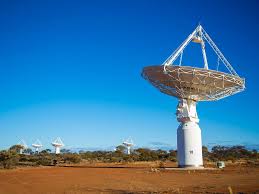
The Great Data Surge: How AI and Giant Antennas are Finally “Leveling Up” the Search for Aliens
The Search Levels Up: 2026’s Massive Leap in Extraterrestrial Detection
In a landmark feature published on May 1, 2026, Astronomy Magazine highlights that the search for extraterrestrial intelligence (SETI) has officially transitioned from a “needle in a haystack” problem to a “big data” solution. For the first time since Carl Sagan’s Contact, the gap between science fiction and technical capability is narrowing, thanks to a 2026 “triple threat” of AI, next-gen telescopes, and the study of interstellar visitors.
The SKA Revolution: A Billion Channels at Once
The “Level Up” refers primarily to the Square Kilometre Array (SKAO) and the upgraded Allen Telescope Array (ATA).
-
Massive Bandwidth: Modern radio telescopes can now tune into one billion channels simultaneously. Compared to the single-channel receivers of the 1960s, our “listening” power has increased by a factor of 1,000,000,000.
-
The 10% Milestone: While the full SKA will eventually cover a square kilometer, the first 10% of its dishes became operational in early 2026, offering five times the sensitivity of any previous single-dish telescope.
-
Technosignatures: Researchers are no longer just looking for “intentional” beacons. They are searching for “leakage”—the same kind of broadband radio, radar, and satellite emissions that Earth has been leaking into space for 100 years.
AI: The New Lead Investigator
At zyproo.online, we track the impact of AI on discovery. In the SETI context, AI is solving the “interference” problem:
-
Filtering the Noise: Earth is incredibly noisy (cell phones, satellites, GPS). AI algorithms can now distinguish between a signal from a Starbucks in Mumbai and a signal from a star system 100 light-years away.
-
Anomaly Detection: Instead of telling an AI what to look for, researchers are using “unsupervised learning” to ask the AI, “Show me anything in this data that looks unusual.” This is how we might find things we haven’t even imagined yet.
Interstellar Guests: 3I/ATLAS and Artifacts
The search “leveled up” literally in our own backyard this May.
-
The 3I/ATLAS Findings: On May 8, 2026, scientists confirmed that the interstellar comet 3I/ATLAS contains “heavy water” levels 30 times higher than our own solar system.
-
The Artifact Hunt: While 3I/ATLAS appears natural, the SETI Institute’s Discovery and Futures Lab used its passage to test “Rapid Response” protocols. If a future visitor—like Oumuamua—shows non-natural traits, we now have the AI-driven radio arrays ready to scan it for technosignatures within minutes.
The “Discovery and Futures” Lab
Launched in early 2026, this new interdisciplinary initiative isn’t just about the how of finding aliens, but the what then. Led by researchers from the SETI Institute, the lab is preparing protocols for:
-
Post-Detection Ethics: Who speaks for Earth?
-
Communication Lag: How do you hold a conversation when the “reply” takes 40 years to arrive?
-
Societal Response: Managing the cultural shock of a confirmed “Second Genesis.”
2026 Milestones
-
6,000 Exoplanets: NASA’s TESS and the MINERVA-Australis array officially pushed the count of confirmed alien worlds past 6,000 this May.
-
LaserSETI Expansion: A global network of optical cameras is now monitoring the entire Northern Sky for brief laser pulses—signs of interstellar communication that radio telescopes might miss.
The search for life is no longer a fringe science. In 2026, it is a high-speed, AI-powered industrial operation. We’ve finally stopped looking through a keyhole and started opening the door.