











How Black Holes “Shredding” Wolf-Rayet Stars Create the Galaxy’s Brightest Blue Light
The Blue Flash Mystery: Black Holes Colliding with “Scorching” Wolf-Rayet Stars
In the vast expanse of the cosmos, astronomers have been haunted by a class of rare, ultra-bright explosions known as LFBOTs (Luminous Fast Blue Optical Transients). These flashes, like the famous “AT2018cow” (nicknamed “The Cow”), appear out of nowhere, glow with an intense blue light, and disappear much faster than any normal supernova. New research published in May 2026 suggests the culprit is a “cannibalistic” relationship between a black hole and the universe’s hottest stars.
The Science: A Stellar “Slam-Dunk”
For years, scientists debated whether these flashes were just “weird supernovas.” However, data from recent events like AT2024wpp (nicknamed “The Wasp”) has shifted the theory. Researchers led by Anya Nugent at Harvard’s Center for Astrophysics now believe LFBOTs occur when a compact object (either a black hole or a neutron star) slams into a Wolf-Rayet star.
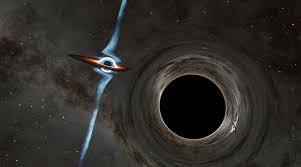
Wolf-Rayet stars are “scorching” stellar remnants that have already lost their outer layers of hydrogen, leaving behind a glowing, super-hot helium core. When a black hole spirals into one of these stars, it doesn’t just sit there—it shreds the star’s core in a matter of days.
Why the Light is Blue (and Fast)
At zyproo.online, we break down the physics of why these are so unique:
-
Intense Heat: Because Wolf-Rayet stars are incredibly hot (over 40,000 Kelvin), the debris from the collision remains blue throughout its entire lifecycle.
-
The “Shredding” Effect: Unlike a supernova, which is a slow explosion from the inside, a black hole collision is a violent, external shredding event. This causes the light to peak and fade in a few days rather than weeks.
-
Relativistic Jets: The research shows that as the black hole devours the star, it ejects jets of material at nearly 40% the speed of light, creating a high-energy signature that cameras can pick up across billions of light-years.
The Environmental Clue: Avoiding the “Nursery”
One of the biggest breakthroughs in this study was looking at where these flashes happen. Unlike typical supernovas that occur in dense “star nurseries,” LFBOTs often happen in unique environments that don’t fit the standard death-of-a-star model. This “mismatch” is what led scientists to the binary system theory—two objects that have been orbiting each other for millions of years until they finally merged in a spectacular blue burst.
This discovery moves us closer to understanding the “missing link” of black hole evolution. We are no longer just watching stars die; we are watching the violent birth of the next generation of cosmic giants.