











Cosmic Camouflage: How an “Optically Dark” Gamma-Ray Burst Revealed a Galaxy’s Hidden Secret
In a breakthrough discovery that feels like a scene from a space thriller, astronomers using the world’s most powerful telescopes have successfully tracked an “optically dark” gamma-ray burst (GRB) to its origin. What they found wasn’t just a dying star, but an unusually massive, dust-shrouded galaxy that had been hiding its rapid star formation behind a thick veil of cosmic smoke.
The event, designated GRB 250702B, has shattered several records and is challenging our understanding of where and how the universe’s most powerful explosions occur.
The Mystery of the “Optically Dark” Burst
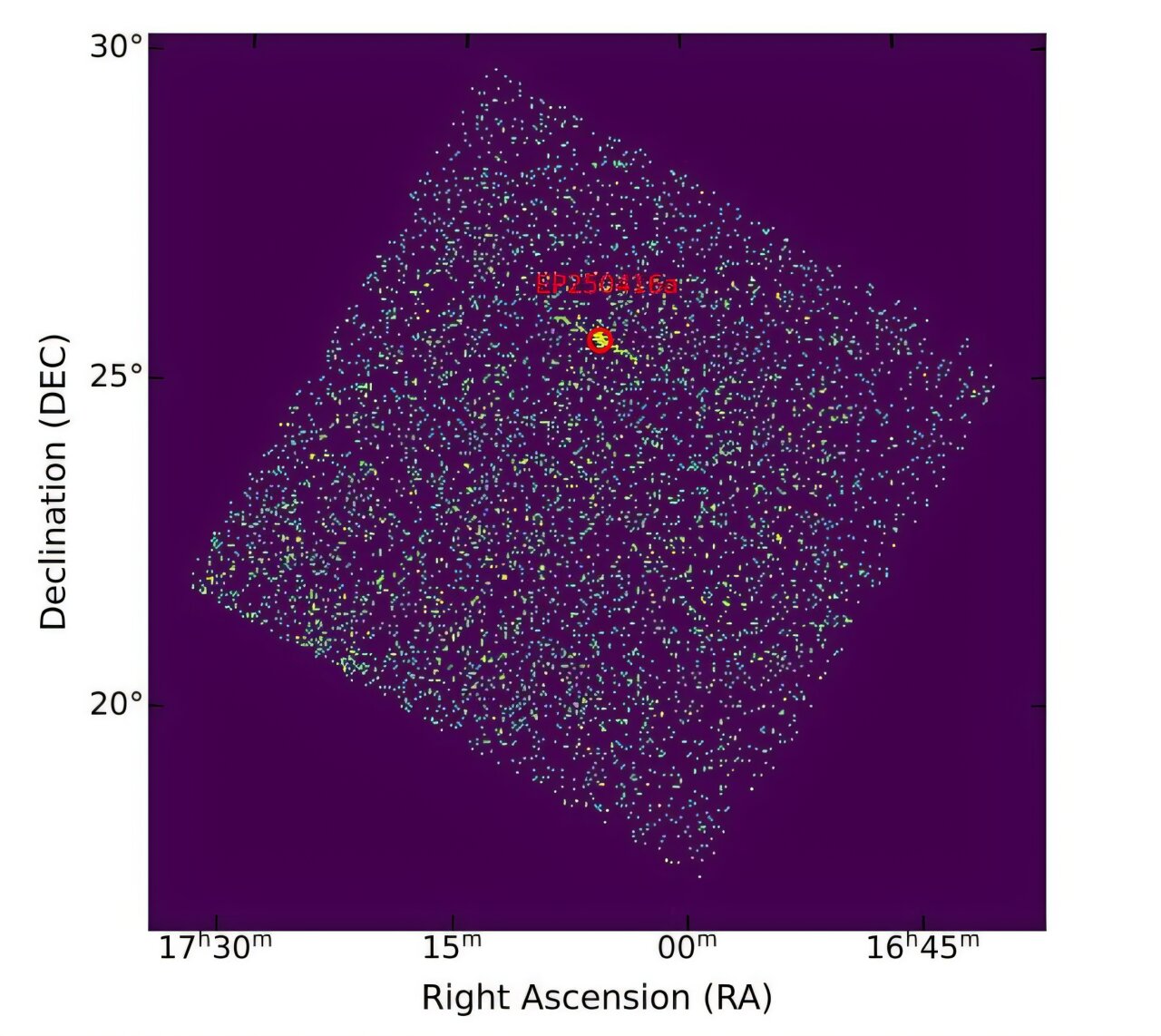
Most gamma-ray bursts are accompanied by a brilliant “afterglow” of visible light. However, GRB 250702B was different. While space-based telescopes like Fermi and China’s Einstein Probe detected intense high-energy radiation, ground-based optical telescopes saw… nothing.
-
The Cause: The burst occurred inside a dense “dust lane”—a river of cosmic soot that acts like a blackout curtain, absorbing almost all visible light.
-
The Solution: Astronomers turned to the James Webb Space Telescope (JWST) and its infrared eyes, which can peer through dust like heat-vision goggles.
A Record-Breaking Event
This wasn’t your average stellar explosion. GRB 250702B exhibited properties that left scientists stunned:
-
Duration: The burst lasted for a staggering 7 hours, making it the longest-duration GRB ever recorded (nearly doubling the previous record).
-
Early Warning: Uniquely, soft X-rays were detected a full 24 hours before the actual gamma rays arrived, a phenomenon never seen before.
-
Energy: It ranks in the top 20 most energetic explosions ever observed in the history of astronomy.
The Discovery: A Galaxy with an Identity Crisis
When the JWST finally pinpointed the location, it revealed a massive, luminous galaxy 8 billion light-years away.
-
Hidden Star Formation: The galaxy is undergoing a “baby boom” of new stars, but because of the extreme amount of dust, this activity was invisible to traditional telescopes.
-
Unusually Massive: Most GRBs happen in small, “wimpy” galaxies. This host galaxy is a giant, roughly the size of our Milky Way, which is rare for this type of event.
-
The Progenitor: The data suggests the explosion was caused by a relativistic jet—a beam of matter moving at nearly the speed of light—launched either by a collapsing massive star or a star being shredded by a black hole.
Why This Matters
This discovery is “game-changing” because it proves that a significant portion of the universe’s star-forming history is likely hidden from us.
-
Cosmic Elemental Forge: These explosions are the only places violent enough to create heavy elements like gold and platinum. By finding where these bursts happen, we find where the universe’s precious metals are born.
-
The Missing Link: The characteristics of this burst hint at the existence of Intermediate-Mass Black Holes—the “missing link” between small stellar black holes and the supermassive giants at the centers of galaxies.